Best Branding Agencies for Deep Tech Companies (2027): 8 Compared, With Real Prices
Eight studios compared on deep-tech scope and terms, with USD peer prices, our own published prices and labelled conversions. Peer research: October 2026.

1. Quick summary
A deep-tech site needs to explain the business and help engineers assess the product. Refract plans technical websites around the questions each audience brings. We design those journeys and give your team a CMS for the technical material. An existing identity can stay in place, with brand work available when the explanation needs to change. Bolder may suit a company still working out how to describe itself before it designs an identity. Everything Design’s deep-tech arm specialises in engineer-led branding and 3D-heavy sites.
Our deep-tech comparison draws on eight studios’ service pages and available Clutch records to check scope and delivery terms. Prices were checked on 2 October 2026. We use the studios’ own dollar figures where available and label our approximate conversions Estimated, using the ECB reference rates for 1 October 2026.
| Pick | Best for |
|---|---|
| Refract (us) | A technical website with clear routes for different audiences |
| Bolder | A company that is hard to explain, with strategy first |
| Everything Design | Engineers who want a 3D-heavy site built by engineers |
We suggest postponing a full identity and website while you’re still deciding the product’s use and buyer.
2. Why is branding hard to get right for deep tech companies?
You need to explain a deep-tech product without making its technical claims less accurate. Product specifications need to remain accessible throughout the site, including when the homepage explains the commercial opportunity. Technical buyers may need to check compatibility or assess an integration before they speak to sales. A broad company story can leave those questions unanswered, especially when the product spans several applications.
3. Why listen to us
Our semiconductor website work includes audience research and the build. The Morse Micro semiconductor brief involved six audiences, including engineers, partners and investors. We used a stakeholder workshop and interviews to plan their routes through the site, then designed the system and built it in Webflow. We continued the work on a retainer.
Andy, VP Marketing at Morse Micro, said: “Love your work Team Refract. From the very first connection, you guys have been sparky and contemporary in your approach. I feel we’re nicely walking that tightrope of pragmatism and creative cut through. Most of all...it’s fun! THANK YOU for the journey travelled so far!”
4. The 8 best branding agencies for deep tech companies: full comparison
| Studio | Best for | Price signal | Timeline signal |
|---|---|---|---|
| Refract (us) | A technical website with clear routes for different audiences | Websites from $15,000. Brand projects usually $15,000 to $100,000 or more Published, no currency stated | Most websites 4–8 weeks. Published |
| Bolder | A hard-to-explain company, strategy first | Startups from $15,000 USD, home and contact pages. Growth and enterprise $50,000–$200,000 USD on home, Series A to IPO brand and site $35,000–$200,000 USD on contact. Published | 2–8 weeks for startups, 6–16 later. Published |
| Everything Design | An engineer-led brand and 3D-heavy site | Brand + website from about $28,000, their USD approximation. Published | 9–16 weeks for Brand + website. Published |
| The Branx | Brand and site bought à la carte | Identity from about $22,600, landing page $5,650, five-page site $14,100. Estimated | Identity three weeks, those sites about two to four. Published |
| Foundation | A fixed-fee brand sprint for advanced hardware | Brand Sprint about $13,200 excluding VAT. Estimated | 10 working days. Published |
| HAUS | PR-first launch with creative alongside | Creative price not published. PR has a three-month minimum. Published term | Creative timeline not published |
| Up Strategy Lab | Semiconductor, sensing and energy brand, site and channel partners | Projects from about $5,650 to well over $113,000. Estimated | Usually three to six months. Published |
| Junca Studio | The website alone once the brand exists | Focused site from about $6,000 USD, larger projects with branding usually $20,000 USD or more. Published | Marketing site 4–6 weeks, with branding or 3D 8–12. Published |
1. Refract: best for a technical website with clear routes for different audiences
We turn stakeholder interviews into a sitemap and page designs for technical buyers. The website build includes reusable components and an editing system for the material your team publishes.
Services. Brand, website and product briefs are all available. See our services.
Price and timeline. Websites start from $15,000, and most take four to eight weeks. When the explanation and identity change too, brand projects usually run from $15,000 to $100,000 or more. We agree the scope and price before work starts. Published, no currency stated.
What clients say. Polly, Marketing Specialist at Kaizn: “We love our new look and website. Thanks so much, your team smashed it.”
Pros. We plan the audience routes, design the website and build its CMS. Your team gets a reusable design system, with the scope and schedule agreed before work starts.
Cons. Hardware and industrial design fall outside our work. You’ll need another specialist for the physical product itself.
Talk to us about your technical website.
2. Bolder: best for a company that is hard to explain, with strategy before the identity
Bolder is an independent B2B tech and deep-tech agency in Berlin and San Francisco. They set a fixed scope and price after discovery, without hourly billing. They can work on strategy, identity and the site in sequence or in parallel. Their work includes Riverkin, Attero and Alicia.
Services. Ongoing design subscriptions are also available.
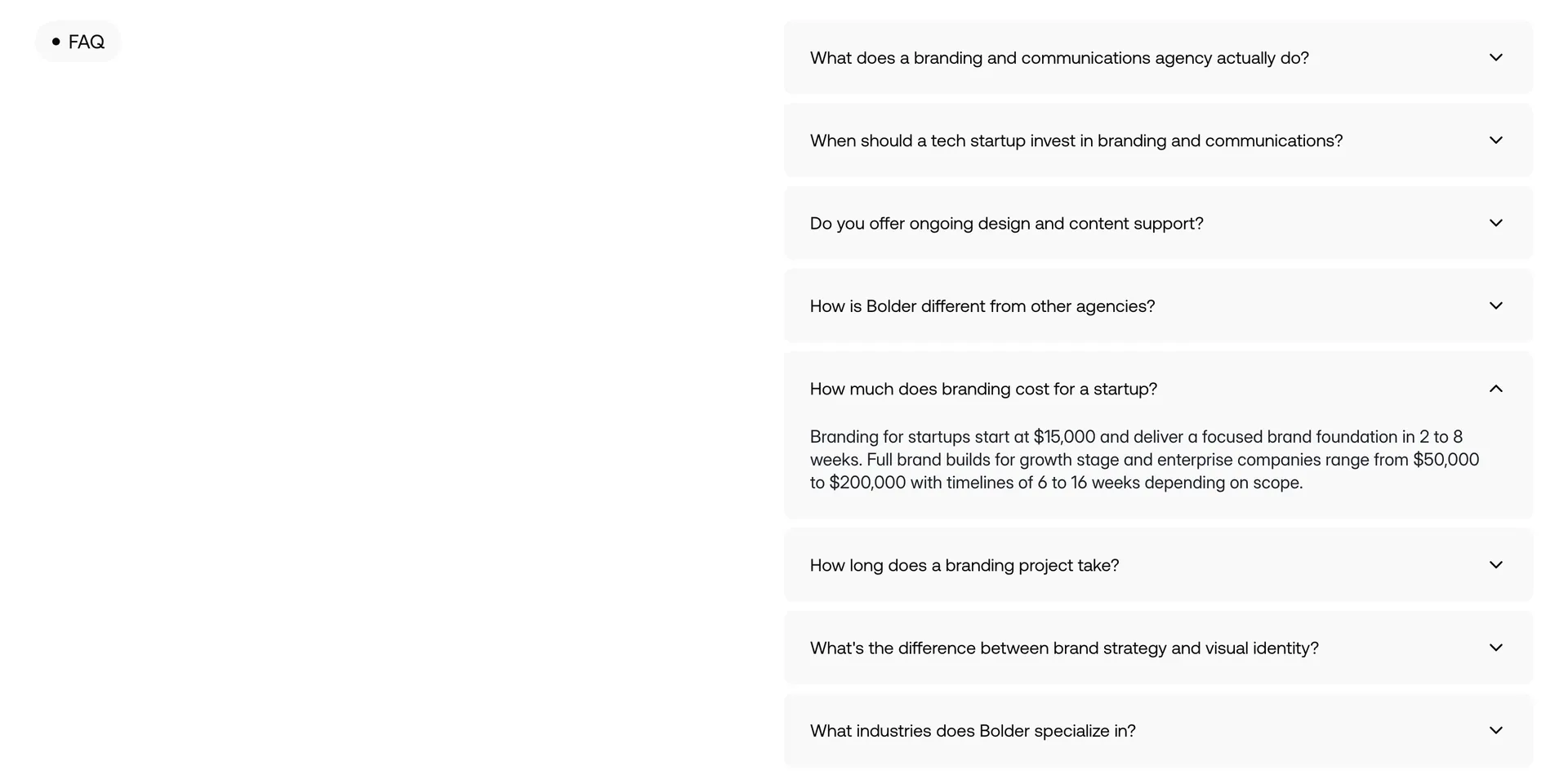
Price and timeline. Bolder’s home FAQ prices startup projects from $15,000 USD over 2–8 weeks, and growth or enterprise brand builds at $50,000–$200,000 USD over 6–16 weeks. The contact FAQ also starts pre-seed and seed projects at $15,000 USD. It lists Series A to IPO brand, strategy and website work at $35,000–$200,000 USD over 6–16 weeks. Their deep-tech page shows $15,000–$200,000 USD, while the services page describes a full startup package taking 6–12 weeks. Published for differently described scopes.
What clients say. Clutch records 5.0/5 across 12 reviews. Riverkin’s CEO said on 9 May 2026: “The team was consistently fast to respond. Questions, feedback, and async messages were always picked up within 1-2 hours, which kept momentum strong across the 9-week engagement.”
Pros. They specialise in explaining deep-tech businesses, with strategy available before visual design. Fixed-scope pricing lets you agree the work without hourly billing. Published.
Cons. Their offices operate from Berlin and San Francisco, so Australian teams need to arrange overlapping review hours. Their published packages also have different scope and timeline descriptions across pages. Ask which offer applies to your launch. Published.
3. Everything Design: best for engineers who want a 3D-heavy site built by engineers
Everything Deep Tech is Everything Design’s Bengaluru arm, with ten engineers across strategy, 3D, delivery and the build. They scope branding, 3D renders and scroll-driven Webflow sites after a 30-minute audit call. Their clients include Armory, Kandou AI and PolyEnergetics.
Services. Launch material can join the brand and website scope.
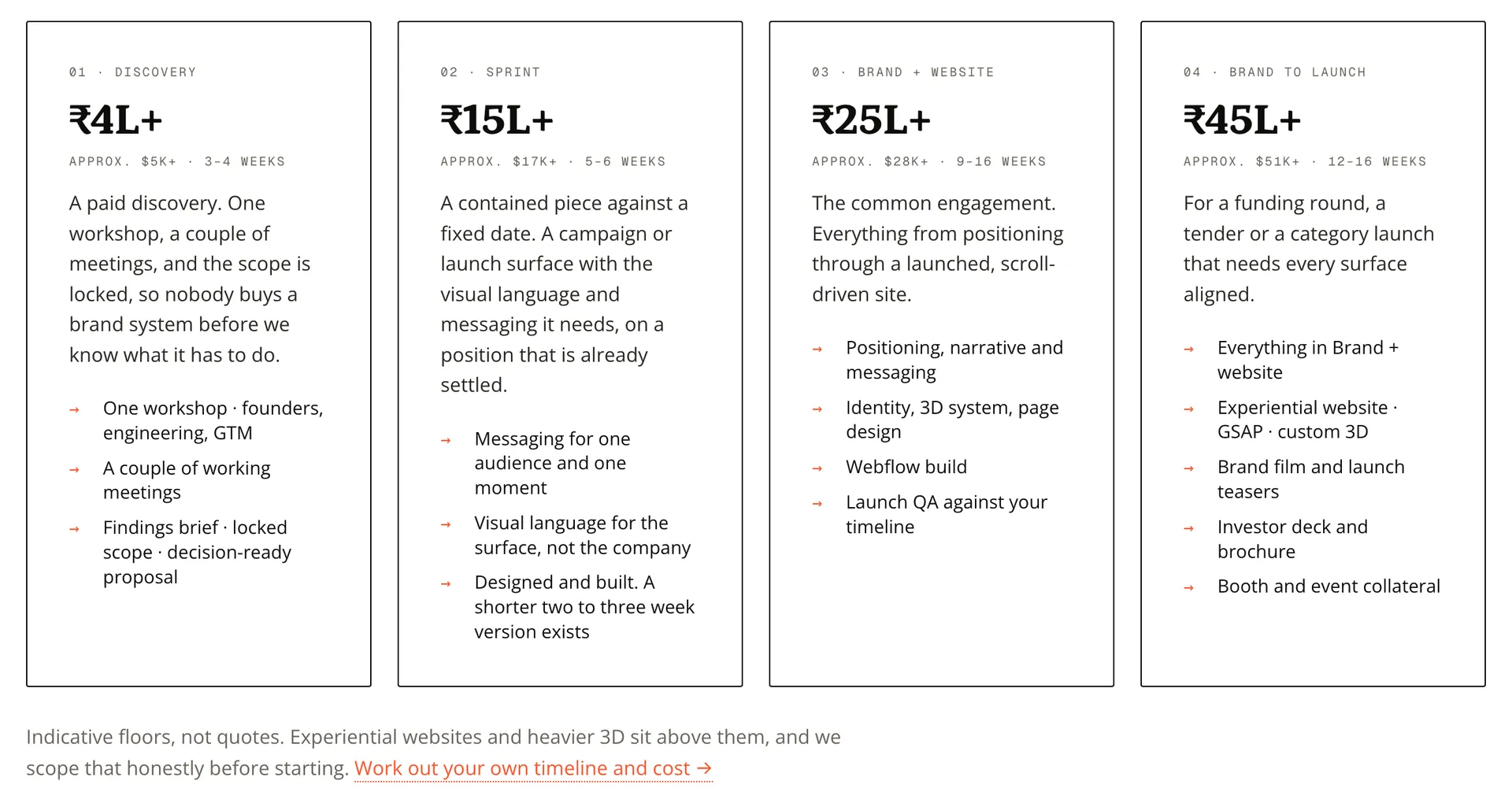
Price and timeline. Discovery starts at about $5,000 over 3–4 weeks. Sprint starts at about $17,000 over 5–6 weeks. Brand + website starts at about $28,000 over 9–16 weeks, and Brand to launch at about $51,000 over 12–16 weeks. Each is a project starting price. These are the studio’s own USD approximations. The conversion is settled when the contract is signed. Published. Ongoing support is approximately $6,200–$20,800 a month, converted from their published price. Estimated.
Pros. Identity, product renders and the Webflow build can be commissioned in one engagement. Clients own the source files outright, allowing later revisions without rebuilding the assets.
Cons. USD figures are approximate and conversion is agreed when you sign. Third-party licences and hosting are billed outside the project fee. Published.
4. The Branx: best for a brand and site priced à la carte and delivered in weeks
Identity is the starting purchase at The Branx, with strategy and websites priced individually. Their deep-tech page offers branding in three weeks. Published. Furanova, Eluviant and Featherless appear on their site.
Services. The identity and messaging can be followed by a separately priced site.
Price and timeline. Identity starts at approximately $22,600 over three weeks, and strategy at $5,650. A landing page starts at $5,650 over about two weeks, a five-page site at $14,100 over four weeks, and a ten-page site at $24,900 over six. A strategic rebrand starts at $28,200. These are approximate USD conversions of their published planning estimates. Estimated.
What clients say. Clutch records 5.0/5 across 37 reviews. A digital marketing and content specialist at a SaaS company said on 26 February 2026: “One area for improvement would be attention to detail around spelling and small typos.”
Pros. Published starting figures let you plan the identity and site as separate purchases. Estimated for our USD conversions. Their website tiers distinguish a landing page from a larger site, helping you choose a scope that fits the material you need to publish.
Cons. The core offer addresses AI and SaaS startups, so hardware explanations need explicit agreement in the brief. Identity and website work are priced separately, and an identity budget alone will not cover the site. Estimated for our USD conversions.
5. Foundation: best for a fixed-fee brand sprint for advanced hardware
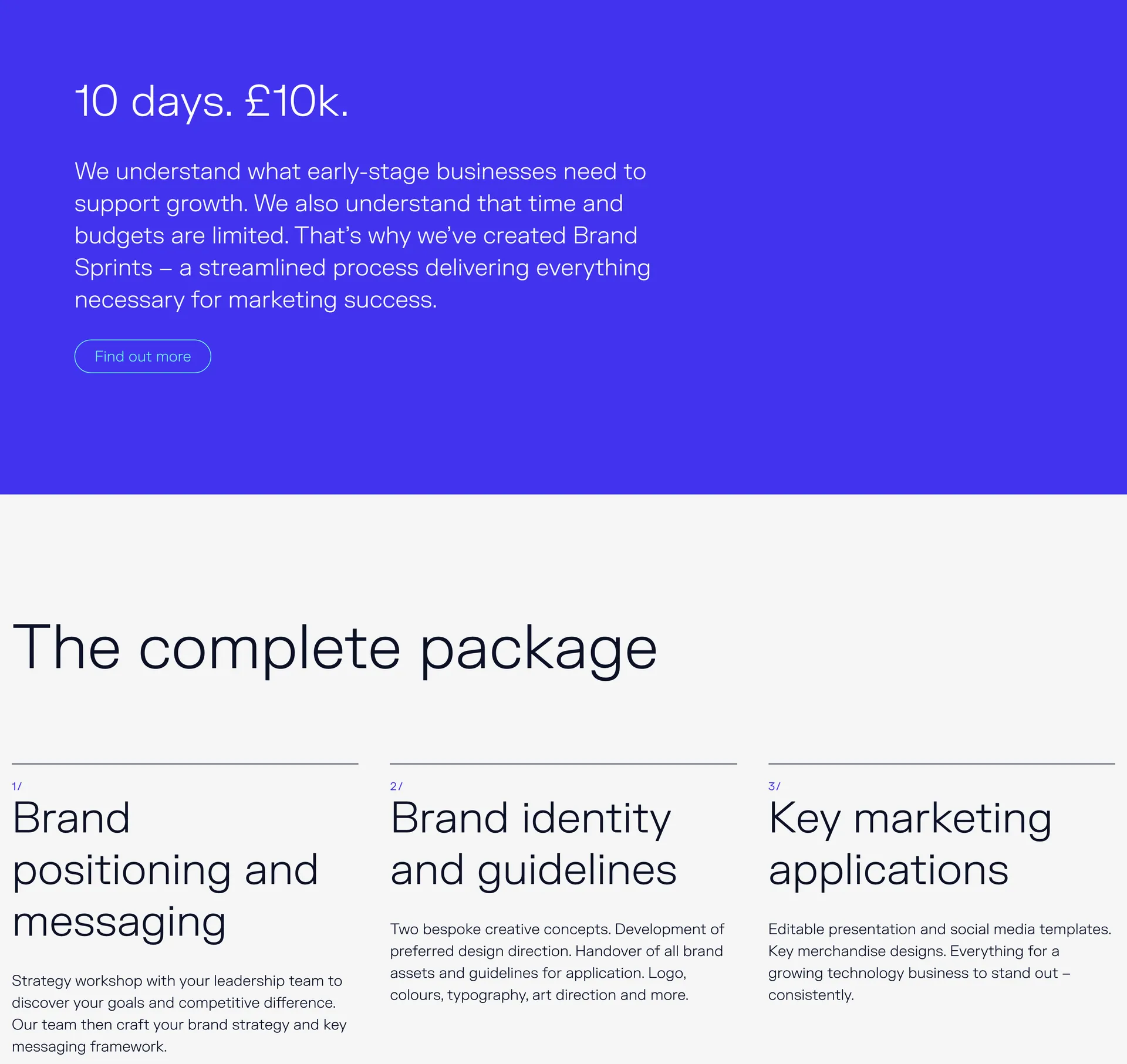
Foundation’s London Brand Sprint starts with a three-hour online workshop. A small team reviews two concepts over two weeks before handover. The sprint includes strategy, identity, marketing applications and a single-page Squarespace site. You supply the domain, Squarespace and Canva Pro accounts. Their work includes Envisics, WaveOptics and OBOT.
Services. Naming is outside the sprint. A fuller website can be scoped separately.
Price and timeline. The sprint is approximately $13,200 excluding VAT over ten working days, with half paid before the workshop and the balance at handover. The USD price is converted from their published fixed fee. Estimated. A small working group needs to stay involved through the two-week process. A fuller website is a separate scope, and naming is excluded. Published.
What clients say. Clutch records 5.0/5 across 12 reviews. Deep Optica’s CEO and Co-Founder said on 14 September 2026: “We found Foundation through an online search. We chose them over other options because Foundation specifically supports the branding design for technology startups, which suits our goal.”
Pros. A fixed fee and defined handover let you agree the brand sprint before the workshop. Published. Marketing applications and a starter site are included, giving the identity an initial use at launch.
Cons. The included website has one Squarespace page and naming is excluded. A larger technical site needs another scope. The same decision-making group must remain available through the sprint. Published.
6. HAUS: best for a brand launched alongside deep-tech PR
HAUS offers public relations and creative services from a New York office and distributed team. Their launch package combines media relations, branding and web development for startups leaving stealth. Their site names Itera, EnCharge AI, Mana Battery and Majestic.
Services. Naming, product renders and video are available within creative work.
Price and timeline. HAUS publishes no creative price or delivery period. Their PR retainer has a three-month minimum, with three-, six- and twelve-month terms. Pricing is updated quarterly. Published terms. Creative price and timeline not published.
Pros. Media relations and launch creative can be coordinated through one agency. Their creative services include product renders, allowing hardware imagery to be part of the launch brief.
Cons. PR engagements require a three-month minimum, even when your immediate need is a launch. Published. Creative fees and dates come only with a quote. Not published.
7. Up Strategy Lab: best for semiconductor, sensing and energy companies that need brand, site and channel partners together
Up Strategy Lab has worked from Gothenburg since 2018. They work with semiconductor, sensing and energy companies on explaining and selling their technology. Brand and web projects can include specialist search and a channel partner programme. Their clients include Frontgrade Gaisler and FreePower.
Services. Naming can form part of the brand and website project.
Price and timeline. Their published project range converts to approximately $5,650 to well over $113,000, with fixed projects usually taking three to six months. A focused site sits near the lower end and a brand, website and product rebuild near the upper end. Your project needs a separate quote within this broad historical range. Estimated for the USD amounts, Published for the duration and scope.
Pros. Semiconductor, sensing and energy work gives you relevant examples of technical selling. A channel partner programme can be included with the brand and site if distributors are part of your route to market.
Cons. Fixed projects usually take three to six months. Published. The range runs from a focused site to a full rebuild, and only a proposal places your project in it. Estimated for our USD range.
8. Junca Studio: best for the website alone once the brand exists
Junca is a brand and web studio in Paris. They build in Framer, Astro and Next.js, with 3D and WebGL available. Clients follow design and build milestones in a shared Notion workspace for review. You can buy a focused site using your existing brand, or add identity to a larger project. Their showcase includes BotBlox, Hylight and Skipper NDT.
Services. The build can include 3D, WebGL and search work.
Price and timeline. Focused Framer sites start around $6,000 USD. Larger projects with branding, 3D or WebGL and copy usually reach $20,000 USD or more. A marketing site takes 4–6 weeks. Adding branding, 3D or animation takes 8–12. Published.
Pros. A focused website can use the identity you already have, reducing the need for a wider brand brief. A shared Notion workspace lets you review design and build milestones as the site develops.
Cons. The focused-site offer assumes an existing identity and a clear product explanation. Adding branding or custom 3D moves delivery to eight to twelve weeks. Published.
5. How we picked these studios
If the product is software, see our shortlist for AI and developer-tool startups.
Deep-tech evidence. Client and service pages had to show hardware, semiconductor, energy or robotics work. Calling the studio a technology agency wasn’t enough.
Scope. We distinguished strategy and identity from product design, website builds and launch programmes. Junca’s focused site and HAUS’s PR-led launch answer different briefs.
Price transparency. We checked the published amount and its conditions, then used USD for comparison. HAUS publishes no creative figure. Our own pricing page names no currency, so our figures appear as it prints them.
Our place on it. Refract wrote this comparison, and our entry is first. The studios were not contacted, and none paid to be listed.
Project model. We checked how each studio scopes the work and how long delivery takes. Each entry needs a distinct reason to consider it, from engineer-led 3D work to a PR-led launch.
6. When 3D, renders and technical diagrams earn their cost on a deep-tech site
A product render can help explain hardware that buyers cannot inspect online. Everything Deep Tech recommends 3D when a screenshot cannot explain the product. Published. We suggest choosing the visual from the technical question the visitor needs answered. An external view may explain the form of a device, but an internal component or installation can need a cutaway, a labelled diagram or several views.
A useful brief names that question and the detail that must remain accurate. Ask your engineering team to approve the geometry, component labels and operating sequence. A photorealistic treatment can still misrepresent a product if the proportions or connections are wrong. Mark conceptual views clearly when the physical design is still changing, and identify who will approve an updated asset after an engineering revision.
Interactive 3D adds another decision: whether rotating or exploring the object helps the visitor assess it. Compare that interaction with a static render and accompanying diagram. We suggest a static version for material that needs to work in a specification sheet or sales deck as well as on the site. Agree the editable asset and export formats in the contract, including any licences needed to revise them.
Performance belongs in the same brief. Set expectations for mobile loading and a usable fallback if the interactive view fails. Keep the product explanation available in text and labels, then test the complete page on the devices buyers use. The work is easier to scope when the agency knows which views explain the product and which are for presentation. Commission only those views, with technical approval and later revisions included in the plan.
7. What branding and a website cost for a deep tech company in 2027
| What you are buying | Price signal (currency shown) | Timeline | What you get | Provenance |
|---|---|---|---|---|
| A website on a settled brand | Junca from about $6,000. The Branx landing page about $5,650, five pages $14,100, ten pages $24,900 | About 2–12 weeks | Website scope varies by platform and build | Published for Junca, Estimated conversions for The Branx |
| A sprint or an identity | Foundation about $13,200 excluding VAT. The Branx identity from about $22,600. Everything Deep Tech Sprint from about $17,000. Bolder startups from $15,000 | 10 working days–8 weeks | Identity or one launch surface. Foundation includes one web page | Published for Bolder and Everything Deep Tech, Estimated conversions for the others |
| Brand and website together | Our websites from $15,000, brand projects usually $15,000 to $100,000 or more, no currency stated. Everything Deep Tech from about $28,000. Bolder $35,000–$200,000 on the contact page, $50,000–$200,000 on the home page for later stages | Bolder 6–16 weeks, Everything Deep Tech 9–16 weeks | Identity, site and CMS by scope | Published |
| A full launch programme | Everything Deep Tech from about $51,000. Up Strategy Lab about $5,650 to well over $113,000 across project scopes | 12 weeks–6 months | Launch material or a partner programme | Published for Everything Deep Tech, Estimated conversion for Up Strategy Lab |
| A brand launched with PR | HAUS gives no creative figure. PR starts at three months | Creative timeline not published | Media relations, brand and web | Published term, creative price Not published |
For interface work, see the product design shortlist for AI startups.
8. When you shouldn’t hire a branding agency
The technology is still changing. A full identity and website may be premature if your team hasn’t settled the product’s use or buyer. Everything Deep Tech recommends category definition and an analyst-ready one-pager for pre-product companies. Your engineering team can help turn the current architecture and technical claims into that smaller brief.
You need one technical asset. A product diagram, specification sheet or investor deck may need a specialist freelancer working from your existing identity. The brief should identify who approves the engineering detail and which editable files you need. A broader brand project adds little if the explanation and visual system already work.
Your team already publishes the material. A design subscription can support recurring diagrams, event collateral and launch assets once your positioning is settled. You still need someone who can review technical accuracy. If the work includes a new product narrative, identity and website, those need their own scope.
The problem is in the product. An unclear interface or a difficult setup flow needs product design. Changing the marketing site will leave those interactions unresolved. Our AI product design shortlist covers studios that work on the interface, including fixed projects and embedded teams.
9. Work with us
A focused website may be enough if you already know how to explain the product and have an identity you want to keep. You don’t need to buy a rebrand to work with us. We can scope the website alone, including the pages and CMS templates your team will use after launch.
For a broader project, we can work on the positioning and identity as well as the site. Our Morse Micro engagement shows how we planned a technical site for different audiences and continued on a retainer. If you’re unsure which scope you need, send us your current site and the brief. We can help you work out what to include.
10. Questions
Everything Deep Tech’s FAQ says clients own their source files outright. Your agreement should also identify the editable 3D assets and website files you receive, plus any third-party licences. Domain and CMS accounts may need a separate transfer. You should agree who owns each account and what the studio will hand over.
Technical approval and feedback remain with your engineering team. Everything Deep Tech asks for a kickoff, a positioning session and two or three technical reviews. Foundation asks a small decision-making group to be available during its two-week sprint. A Bolder client’s CEO said in a Clutch review that taking 5–10 days to return feedback stretched the project timeline.
Positioning comes first, with page design based on the agreed explanation. The identity and website can then be produced in parallel. Bolder describes sequential or parallel delivery of strategy, identity and web as one system. Everything Deep Tech’s FAQ warns that commissioning the site before deciding how to explain the company can mean paying twice.
No. A fundraise alone isn’t a reason to replace the identity. Everything Deep Tech’s FAQ suggests category definition and an analyst-ready one-pager for pre-product teams. We suggest testing your current deck with someone unfamiliar with the technology. That can show whether you need a clearer explanation before commissioning a full brand project.
A specification or architecture diagram and the latest investor deck are useful starting inputs. Everything Deep Tech asks for those inputs and a call with the decision-maker. Someone on your team also needs to approve technical claims. On the Morse Micro website, we used stakeholder interviews to plan the routes different audiences needed before starting design.
Hosting and domain renewal continue after the website project, along with any paid integrations. Maintenance depends on what your team can edit in the CMS and what needs a developer. You should request a separate scope for fixes and code changes, plus instructions for adding pages and access to the site’s accounts.
Written on by
 Refract