Best Product Design Agencies for AI Startups (2027): 9 Compared
Nine studios compared on AI-product evidence, engagement model and price provenance, with current Refract engagement models and sourced peer prices.

1. Quick summary
An AI interface needs to let users review the model’s output and decide when to intervene. Refract designs the first interface for a pre-seed product and redesigns existing applications. Ongoing product work can use an embedded monthly team, with people, scope, minimum term and notice agreed upfront. We join customer interviews and planning, then design in Figma and, where it’s in scope, in code. Lazarev focuses on complex, data-heavy interfaces. Glow publishes a retainer with a project manager, design lead and senior product designer.
The nine-studio shortlist compares product-design arrangements and commitments against the available prices. We read service pages and client reviews, with figures checked on 2 October 2026. Directory minimums describe the smallest projects studios report to Clutch, in US dollars. Glow publishes in USD, and our pricing page names no currency. Your proposal sets the engagement price.
| Pick | Best for |
|---|---|
| Refract (us) | An AI startup building its first interface, redesigning a product or adding an embedded design team |
| Lazarev | A complex, data-heavy interface |
| Glow | A retainer at a published price |
Your team may be able to improve a working prototype without hiring a studio.
2. Why is product design hard to get right for AI startups?
People using an AI product need to review its output and decide when to intervene. Designing that interaction takes more than a set of screens for the model’s ideal response. Your team also needs to agree how the interface handles uncertain results and what a user can change. As engineering changes the model, designers may need to revise those decisions during the build. A fixed brief can be hard to maintain through that process.
3. Why listen to us
Product work at Refract includes interfaces for planning, buying and managing ongoing operations. We designed the planning and buying interface and design system for Lumos, an out-of-home media platform. For Managed, a white-label property platform, we worked on the brand and product. Our AI-company work also includes brand and web for Trusst AI and Mono AI.
Refract has killed it again. We call your team FEDEX because you always deliver!!
4. The 9 best product design agencies for AI startups: full comparison
| Studio | Best for | Price signal | Timeline signal |
|---|---|---|---|
| Refract (us) | A first interface, a full product redesign or an embedded team | From $10,000 a month · embedded team $10,000–$30,000 a month Published, no currency stated | Focused work 4–6 weeks, full engagement 10–16 Published |
| Lazarev | A complex, data-heavy AI interface | $100,000+ minimum project, $100–$149/hr Directory, Clutch | Design typically 8–12 weeks Published |
| MetaLab | A consumer AI product with brand and engineering alongside | $100,000+ minimum project Directory, Clutch | Not published |
| Punchcut | Agents and human-in-the-loop interfaces | Not published | Not published |
| Glow | A retainer team at a published price | Retainer $12,000/mo · MVP $12,500 · Discovery Week $3,500 Published | MVP four weeks, retainer three-month minimum Published |
| Character | Product, brand and site from a small embedded team, paid partly in equity | Hourly rates and equity, no figure Not published | Fractional, in a shared Slack Published |
| UX studio | Research-led UX embedded in a B2B product team | $10,000+ minimum project, $50–$99/hr Directory, Clutch | Not published |
| The Gradient | AI-native consumer, health and fintech experiences | $25,000+ minimum project, $50–$99/hr Directory, Clutch | Not published |
| Clay | Product and brand together at growth stage | $50,000+ minimum project, $150–$199/hr Directory, Clutch | Not published |
1. Refract: best for a new AI interface, a product redesign or an embedded team
New interfaces and complete redesigns are both part of our product practice. An embedded team can also join your product process, on your board and in weekly reviews. For Keeyu, which helps large retailers manage issues after an order, we worked with their product and engineering team on product, web and motion. The screens use shared building blocks, including an AI workflow step. For Atrium, a CRM that monitors communications and drafts follow-ups, we audited the interface and designed shared patterns with their interaction states, including mobile.
Services. A product-only brief can cover the full application or specific flows. Brand and website design are available if needed. See our services.
Price and timeline. Product design starts from $10,000 a month, and an embedded team runs $10,000 to $30,000 a month. The journeys involved, research access and technical constraints set the quote, and we agree it before work starts. Published, no currency stated. A focused piece of product work usually takes four to six weeks, and a full engagement ten to sixteen weeks. Published.
What clients say. “No really, I never thought we could ever have such an awesome website. I would see other brands and go, how did they do that. Now I know how: work with an awesome agency like Refract.” (Jevon, Founder and CEO, Keeyu, on the website)
Pros. We design new products and full interface redesigns, as well as providing an embedded monthly team. Design systems can be built in code as well as Figma, and product, brand and website design can come from the same team.
Cons. An agreed scope and team define our monthly capacity. Extra product streams need a scope discussion when several teams want design work at once.
Discuss the product decisions you need help with.
2. Lazarev: best for a complex, data-heavy AI interface
Complex AI and data-platform redesigns are Lazarev’s focus. The San Francisco studio has worked on AI products since 2017, with a retainer model for late-seed to Series B companies. Their work includes Accern and Peel.
Services. Launch support accompanies interface design and AI interaction work.
Price and timeline. Lazarev’s Clutch profile gives a $100,000+ minimum project size and $100–$149 an hour. Directory, Clutch. Lazarev says most AI and B2B projects take 8–12 weeks for design, or 3–6 months including rollout, with shorter fixes and complex platforms scoped separately. Published.
What clients say. 5.0/5 on Clutch from 19 reviews. “The workflow and process is one of the best I have worked with including my experience with much larger companies.” (Co-Founder, Encyro Inc, 5 stars on Clutch, 2 December 2022)
Pros. AI interaction patterns are part of their design process, with discovery preceding the interface work. Your team receives pattern libraries and a design system it can extend during rollout.
Cons. Their $100,000+ project minimum is a large first commitment. Directory, Clutch. Retainer pricing comes only with a scoped proposal. Not published.
3. MetaLab: best for a consumer AI product with brand and engineering alongside
MetaLab combines product design, brand and engineering in their Suno project. Windsurf and Robinhood also appear in their portfolio. The studio has designed product interfaces and their brand systems since 2006.
Services. Engineering is available with product and brand design.
Price and timeline. MetaLab reports a $100,000+ minimum project size to Clutch. Directory, Clutch. The site gives no price or timeline. Not published.
Pros. Product design and engineering can be included in one project, reducing separate coordination of the interface and build. Brand work is also available within that brief when the application needs a new identity.
Cons. The directory minimum is $100,000+, a large commitment for a first interface. Directory, Clutch. No standard delivery period is published. Not published.
4. Punchcut: best for agents and human-in-the-loop interfaces
Agent interfaces form part of Punchcut’s human-centred AI work. Founded in San Francisco, they have worked for more than two decades. Their clients include Google AI and Amazon Web Services, as well as Samsung XR Media, Nissan, LG and Medtronic. Tomo is their generative-assistant concept.
Services. AI services cover multimodal interaction, agent workflows and governance frameworks.
Price and timeline. Punchcut doesn’t publish a price or a timeline, and their Clutch profile carries no band. Not published.
Pros. Their AI work covers cooperative user overrides, useful when an agent acts on a person’s behalf. Prototyping is part of their AI-design services, allowing interaction decisions to be tested before a full interface build.
Cons. Their site and directory profile give no price band or delivery period. Not published. If the agent experience needs testing before a launch, ask for a prototype scope and date.
5. Glow: best for a retainer team at a published price
Glow assigns a full-time senior product designer on the retainer, supported by a design lead and dedicated project manager. Weekly reviews focus on your metrics, with updates every two days and async Slack. Published. Their cases include Dropcall.
Services. Glow assigns product designers through a retainer or designs a fixed-scope MVP. You can also commission a fixed-price repair of an AI-built prototype or an enterprise engagement.
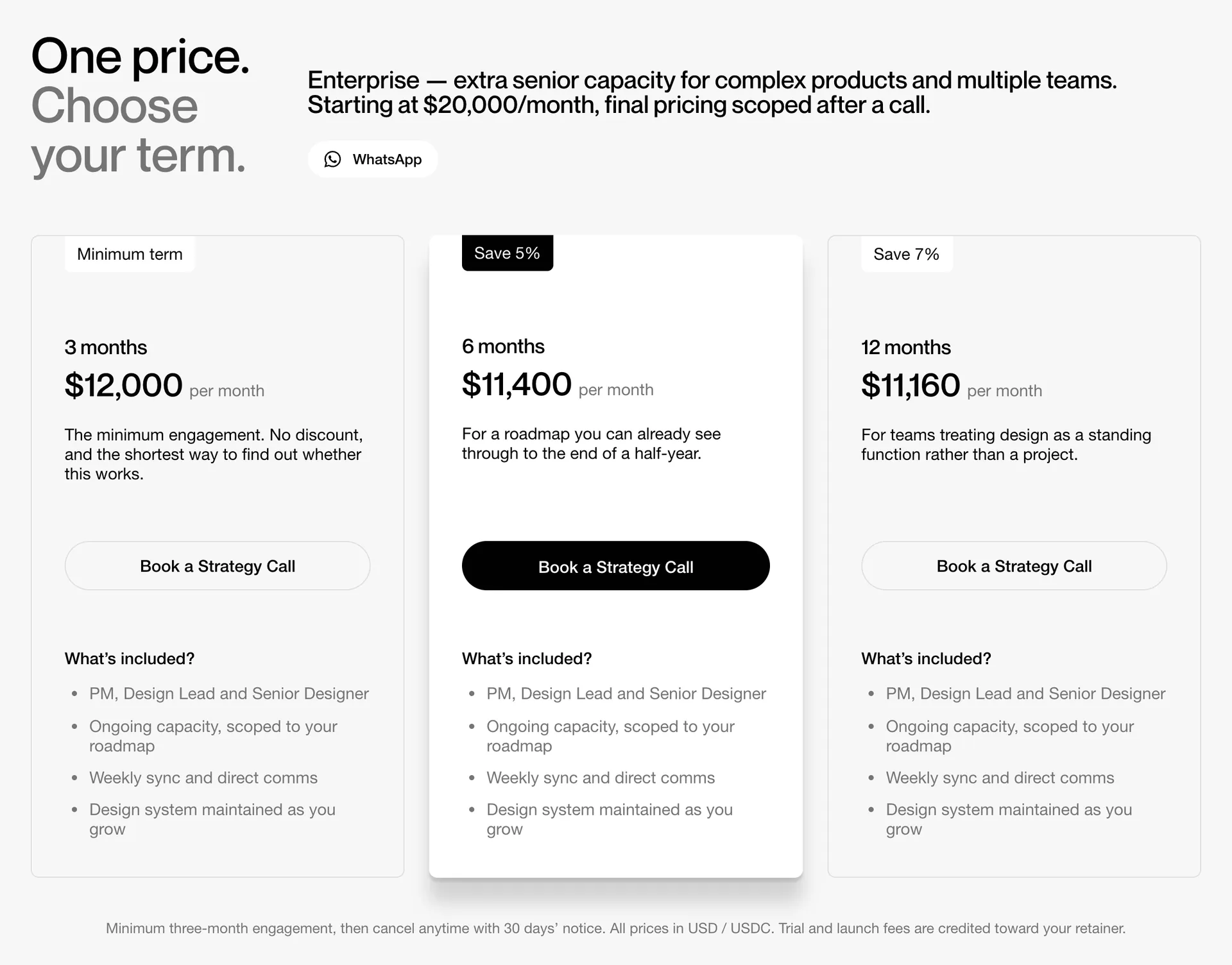
Price and timeline. The Design Retainer includes a project manager, design lead and senior product designer for $12,000 a month. The minimum is three months, followed by 30 days’ notice. Six- and twelve-month terms cost $11,400 and $11,160 a month. The MVP is $12,500 over four weeks at a fixed scope, with 50% upfront. Discovery Week is $3,500, credited toward an MVP started within 30 days, and Enterprise starts at $20,000 a month. Published, in USD or USDC.
What clients say. 5.0/5 on Clutch from 38 reviews. “The Glow’s work is foundational to the success of our business as it directly supports the creation of user experiences that differentiate our product in a highly competitive market.” (Product Manager, Lendflow Inc, 5 stars on Clutch, 12 August 2024)
Pros. The retainer identifies the project-management and design roles, giving your team a clear working arrangement. Weekly reviews and regular updates support feedback during product development. Published.
Cons. The retainer requires three months and then 30 days’ notice, committing you beyond a single design iteration. Published. Glow designs how users interact with AI and does not build the model. That engineering stays with your team.
6. Character: best for product, brand and site from a small embedded team paid partly in equity
A shared Slack and fractional work with your existing team define Character’s engagement. The duo prefers Seed to Series B founders, while also working with later-stage innovation teams. Their portfolio includes Oxide and Clove.
Services. Product, website and brand design are available fractionally.
Price and timeline. The model is one line on the about page: “We work with hourly rates and equity.” The hourly rate and the equity terms are not published, and neither is a timeline. Published for the model, Not published for any figure.
Pros. Fractional work can add product design to your team without a full-time hire. The duo covers the product, website and brand within the same working relationship, helping you coordinate changes across them.
Cons. Hourly rates and equity terms are unpublished, and both the cash and the ownership terms need agreeing before you commit. Not published. They accept a small number of clients each year, so the start date depends on availability.
7. UX studio: best for research-led UX embedded in a B2B product team
B2B SaaS teams can hire a fully dedicated UX team from UX studio. Their designers use your Slack, Linear and Figma. A scoped proposal defines the team and billing arrangement. The Budapest studio shows work for Brenntag and Lupl.
Services. Consultancy and development are also offered.
Price and timeline. The fixed price or rate card comes after a scoped call. Clutch lists a $10,000+ minimum project size and $50–$99 an hour. Directory, Clutch.
What clients say. 5.0/5 on Clutch from 41 reviews. “UX studio quickly learned what our company did, including our highly specific, detailed user journeys and workflows.” (Software Dev Manager, OQ Training & Compliance Management Co, 5 stars on Clutch, 13 October 2025)
Pros. Dedicated designers join your product tools, allowing design work to follow the team’s existing process. Researchers participate in decisions during the engagement, bringing user evidence into interface changes.
Cons. The dedicated team works inside your product tools, which takes access and review time from your own team. A fixed price or rate card arrives only after scoping. Not published for the proposal price.
8. The Gradient: best for AI-native consumer, health and fintech experiences
The Gradient works on AI transformation and AI interfaces. Their portfolio includes the health-intelligence product Norvana and teen banking at Cashee in the MENA region. Infer.bid is a GPU marketplace, while Lumiere provides video intelligence for studios.
Services. AI transformation and interface design can form part of the engagement.
Price and timeline. Their Clutch profile gives a $25,000+ minimum project size and $50–$99 an hour. Directory, Clutch.
What clients say. 4.9/5 on Clutch from 57 reviews. “The most impressive thing was The Gradient’s knowledge of using AI tools properly, and to their advantage.” (Founder, Inferoute, 5 stars on Clutch, 11 August 2025)
Pros. Their remit includes AI transformation, allowing broader changes to the experience as well as interface design. Consumer, health and financial-product work provides relevant examples if your application needs those workflows.
Cons. The $25,000+ minimum is a directory signal, and your product needs its own quote. Directory, Clutch. No fixed delivery term is published. Not published.
9. Clay: best for product and brand together at growth stage
Mobile and enterprise UX were Clay’s starting services, followed by branding. Their offices are in the US and Europe, with Earnin among their clients. Discovery determines whether a project uses time and materials, a fixed fee or a retainer.
Services. The brief can include both the brand and product interface.
Price and timeline. Clay uses a blended rate without a published figure. Their Clutch band is a $50,000+ minimum project size and $150–$199 an hour. Directory, Clutch.
What clients say. 4.8/5 on Clutch from 32 reviews. “Their services aren’t super affordable, but well worth the spend.” (CEO, Spike, 5 stars on Clutch, 24 September 2024)
Pros. Product UX and branding can be designed within one engagement, helping you coordinate the application with its identity. Fixed-fee, retainer and time-and-materials arrangements are available after discovery, allowing the billing model to reflect the brief.
Cons. Their directory minimum is $50,000+. Directory, Clutch. Package fees and a standard delivery period are unpublished, so agree how scope changes are charged before a changing brief starts. Not published.
5. How we picked these studios
For positioning and identity work, see our branding shortlist for AI and developer-tool startups.
AI-product evidence. We read the product and client pages for examples of AI interfaces. A general UX service alone didn’t establish experience with this work.
Engagement model. An embedded designer works with your team differently from a fixed-project studio. We checked each studio’s description of the working arrangement and commitment.
Price. We recorded every published figure with its source, and used a directory band only where a studio publishes nothing.
Independence. Studio sites and directory profiles had to identify an independent business. We excluded studios that had become part of a larger group.
Scale and availability. We recorded the team size and working model where published. These help you compare a two-person fractional studio with a dedicated retainer team, though they don’t confirm an available start date.
Our entry. We wrote this shortlist and put Refract first, under the same evidence checks as everyone else. No studio paid to be included.
6. Prototyping an AI product with real model output instead of ideal responses
A prototype built around a polished example can miss the decisions users face with a live model. We suggest testing the core flow with output from the model your engineers expect to use. The first prototype can remain small, but it should expose enough of the response for users to judge whether they can complete the task.
Ask engineering to prepare examples from representative inputs, including incomplete requests and results that need correction. Include the waiting period, an interrupted request and an unsuccessful response. Designers can use recorded responses while the integration is being built, provided the team keeps track of which behaviours are simulated. A live connection becomes useful when response variation affects the interaction you are testing.
The test should follow the whole task. Let a participant submit their own input, inspect the response and decide how to use it. Watch whether they understand which parts came from the model, how they would correct an error and whether they can stop an action before it affects other work. A revised answer or a recovery flow may need testing as well as the first successful response.
Agree with the product team how those observations will change the prototype. Someone must decide whether the next revision belongs in the model, the interface or the workflow around it. Keep those decisions attached to the examples that prompted them, and test again after engineering changes the response. The same screen can need a different interaction when the output becomes longer or less predictable. Our recommendation is to approve the tested behaviour with product and engineering before committing to a full set of finished screens.
7. What product design for an AI startup costs in 2027
| What you are buying | What studios publish | Timeline | What you get | Provenance |
|---|---|---|---|---|
| A trial or a discovery week | Glow: a free 3-day trial on your product. Discovery Week $3,500, credited toward an MVP started within 30 days | 3 days to 1 week | Trial design work, or a plan | Published |
| A scoped product design project | Refract product design from $10,000 a month, no currency stated, with the interface, flows and price agreed upfront | Focused work 4–6 weeks, full engagement 10–16 | A new interface or a redesign | Published |
| A fixed MVP or sprint | Glow MVP $12,500, four weeks, 50% upfront. Refract one-week trial sprint $2,500, credited against work started within 60 days | Refract sprint one week, MVP work usually 8–12 weeks | A defined outcome | Published |
| A retainer team | Glow Design Retainer $12,000 a month, three-month minimum. Our embedded team $10,000 to $30,000 a month, no currency stated. Glow Enterprise from $20,000 a month | Ongoing | An embedded team | Published |
| A project at a studio that publishes no figure | Clutch minimum project size: Lazarev $100,000+, MetaLab $100,000+, Clay $50,000+, The Gradient $25,000+, UX studio $10,000+ | Months | A scoped project | Directory |
| An embedded team paid partly in equity | Character: hourly rates and equity, no figure | Not published | Product, product website and brand | Published for the model, Not published for a figure |
Compare the monthly engagement terms alongside the scope. Our pricing page lists the current offers in dollars without naming a currency.
| Refract embedded team | Glow Design Retainer | |
|---|---|---|
| Price | $10,000 to $30,000 a month Published, no currency stated | $12,000 a month Published |
| Who is on the account | People agreed before the first month | A project manager, a design lead and a senior product designer. The designer is full-time |
| Cadence | Your board, sprints and weekly working reviews | A weekly sync, updates every two days and async Slack |
| Research and planning | Scope agreed with your team before work starts | A weekly sync tied to activation, retention and conversion. Interviews are not stated |
| What is designed | Product work, with brand, website and engineering available by scope | Product design. Branding and landing page design are also advertised separately |
| Term | By the month, with any minimum term and notice agreed upfront | A three-month minimum, then 30 days’ notice, with 5% off at six months and 7% at twelve Published |
| The smaller commitment beside it | A one-week trial sprint for $2,500, credited against work started within 60 days Published | An MVP at $12,500 in four weeks and a Discovery Week at $3,500 Published |
8. When you shouldn’t hire a product design agency
Keep design in-house if your team can test and revise the interface as the model changes. An agency still needs your product knowledge and decisions.
A freelancer may cover one flow or a set of components. Glow offers fixed-scope work after reviewing the prototype.
Marketing graphics need a different brief from the product’s flows and interaction states. Our design subscription shortlist compares that work. The Superside alternatives guide also includes product design options, with each studio’s scope stated separately.
9. Work with us
If you need a dedicated project manager alongside product design, Glow’s retainer includes one. For complex AI and data platforms, compare Lazarev. With us, you can choose a scoped product design project or ongoing work with your team.
We can develop the interface while your engineers build the product, or build it with them. Include brand and website work if they need to change with it. Our services page explains the scope, and you can tell us about the product you are building or redesigning.
10. Questions
A weekly meeting and feedback between reviews are part of the retainer commitment. A Clay client, an Associate Creative Director at Vestmark, advised on Clutch on 7 April 2026 to “come into the engagement with a clear understanding of your objectives and provide as much context and background as possible.”
Changes outside an agreed scope can increase the project price. A Clay client, the COO of Be GLAD, wrote on Clutch on 3 October 2024: “Eight weeks into our project, there was a change order to the statement of work that increased the cost beyond our initial budget.” Glow’s MVP has a fixed scope. Their retainer and our embedded team charge by the month, with agreed inclusions.
No. Model development can remain with your engineers while a studio designs the interface. Glow describes its remit as designing how people use AI. On our retail order-management project, we worked with the client’s product and engineering team, who were responsible for building the product. Your brief should identify who owns each part of the build.
Usually not if your team can make the repairs itself. Send the current prototype for review and request a fixed repair quote if you need outside help. Glow offers a free three-day trial in which a designer redesigns one real product screen.
We design in Figma, build the design system in code when it’s in scope and define shared component patterns. On the Atrium project, those patterns included the interaction states engineering needed to build. Lazarev describes pattern libraries and design systems that your team can extend. The handover should include the behaviour of each component as well as its appearance.
Ownership depends on the contract, so ask for the design-file rights in the statement of work. Glow’s retainer page says “The work is yours from day one” and lists dev-ready Figma files with specs and components among the output, and their fixed-scope page says the source files are yours.
Written on by
 Refract