Focus Lab Alternatives (2027): 8 Studios for B2B Brands
Compare eight Focus Lab alternatives for B2B branding, from leadership alignment and naming to a scoped rebrand and website, with prices and limits.

1. Quick summary
Focus Lab helps B2B teams design a new brand and roll it out. For a defined B2B launch, Refract handles the new identity and the website in one project. We base the work on the business and audience, then build the site for your staff to edit after launch. A brand-only or website-only brief is also welcome. Our proposal defines the deliverables and price. When the uncertainty is inside the leadership team, Motto would be a strategy option. Lexicon Branding specialises in the company name itself.
Our eight-studio comparison draws on service and pricing pages, published work and Clutch reviews, checked on 3 October 2026. Directory minimums indicate the project size each studio declares to Clutch, without pricing a specific rebrand. The Branx’s EUR prices were converted using the latest ECB reference rate, dated 2 October 2026.
| Pick | Best for |
|---|---|
| Refract (us) | A B2B rebrand and website with one scoped launch |
| Motto | Leadership agreement on positioning and category strategy |
| Lexicon Branding | A new company or product name |
Focus Lab’s dedicated B2B rebrand programme covers mergers and complex brand structures.
2. Why a B2B rebrand needs agreement beyond the identity
A B2B rebrand affects sales teams and customers. Staff in each part of the business must be able to explain the firm and how its products relate to each other. Those questions stay open if you settle the logo but never the message or the brand structure. The website needs the agreed message too, and a team assigned to build it and keep it up to date.
3. Why listen to us
Kaizn’s rebrand brought identity, a Webflow build and sales materials into the same launch brief. We designed those materials for the contact-centre technology company as one project. We design identities and build the websites that carry them. The Trusst AI work shows how our website engagement developed from an initial build into new sections and redesigned pages.
Super proud of the vision, energy & distinctive taste that went into bringing our refreshed brand to life.
4. What Focus Lab costs in 2027
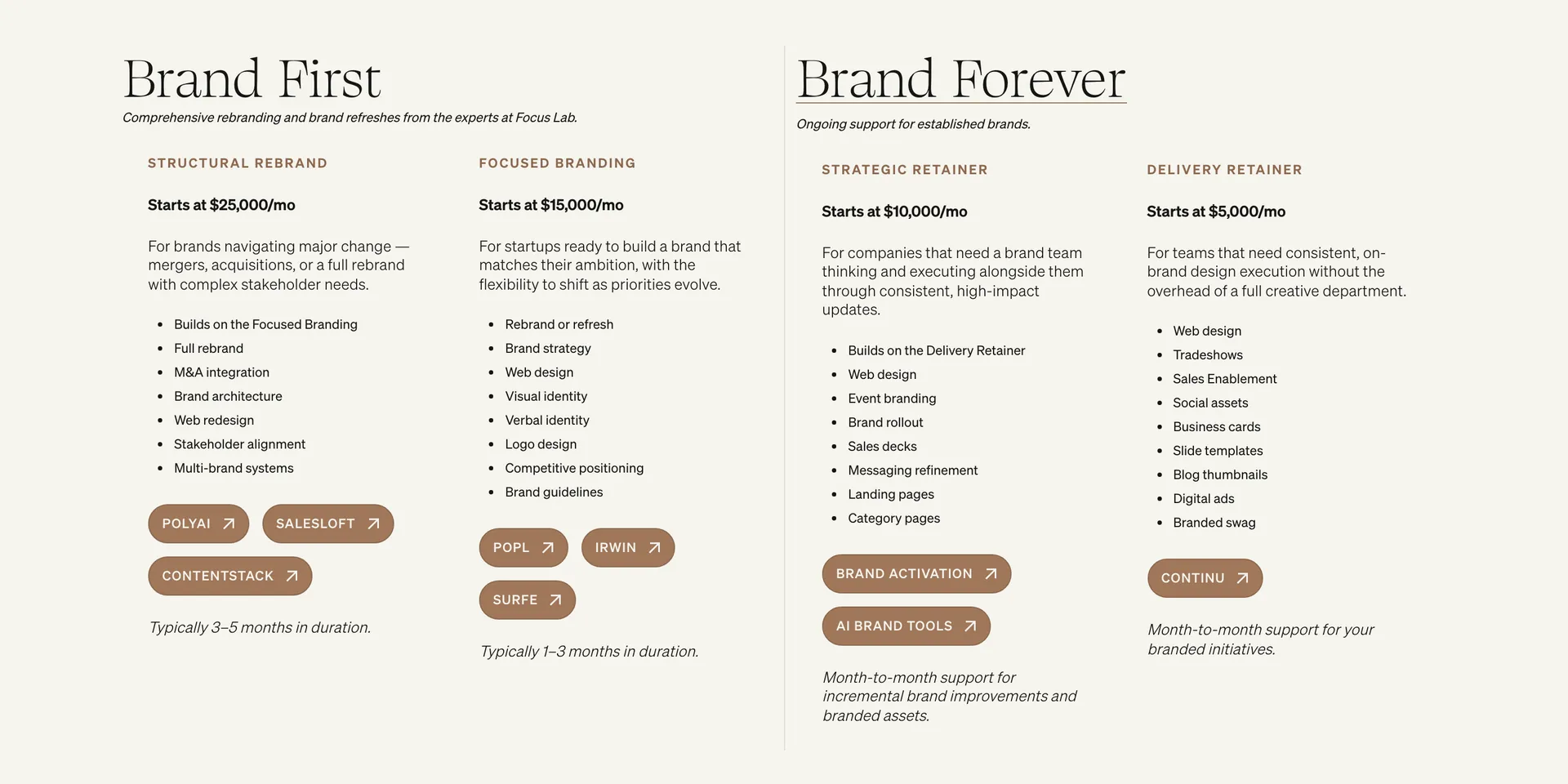
- Focused Branding: USD 15,000/month at the start, typically for one to three months, with an approximate project total of USD 15,000–50,000 in the FAQ. The scope covers strategy, visual and verbal identity, competitive positioning, guidelines and web design. Published.
- Structural Rebrand: typically three to five months, from USD 25,000/month, and the published approximate total is USD 75,000–350,000. It adds merger and acquisition work, stakeholder alignment, brand architecture and multi-brand systems. Published.
- Delivery Retainer: the main services card says USD 5,000/month, the expanded card says USD 6,000/month and the FAQ says USD 5,000/month. The listed execution work includes web design, sales materials, social assets and slide templates. Published.
- Strategic Retainer: from USD 10,000/month for ongoing brand thinking and execution, including rollout, messaging refinement and landing pages. The FAQ describes both retainers as month-to-month with a 30-day money-back guarantee. Published.
The published project totals vary with scope. Focus Lab builds smaller brochure sites in Webflow and refers larger or more complex builds to partners.
Focus Lab meets with you each week and sends work on Fridays with recorded walkthroughs. Your team sends one set of feedback. 5.0/5 from 3 Clutch reviews.
“Working with Focus Lab is like seeing a really good therapist. You talk it out.” Brand Director, Zello, Clutch, 5.0/5, 22 February 2024.
5. Why people leave Focus Lab
The rebrand budget exceeds your scope
Your leaders may have agreed on the direction, leaving a brand and site to get ready for launch. A scoped project fits that brief. A wider rebrand brings workshops across teams and a plan for acquired brands. Focused Branding already serves startups. If you’re early-stage, that alone is no reason to switch.
Focus Lab doesn’t name companies
Their FAQ says they may suggest product or sub-brand names during brand-architecture work and can refer you to naming partners. For the company name itself, Lexicon Branding is a naming specialist, and you can keep Focus Lab for the rest of the rebrand.
You want the website built on another platform
For a WordPress build, talk to Bop Design. An app designed or built as part of the rebrand is a wider brief, and our Ramotion alternatives comparison covers it. The alternatives to Clay’s design agency focus on product design and builds.
6. The 8 best Focus Lab alternatives for B2B brands: full comparison
| Studio | Best for | Price signal | Timeline signal |
|---|---|---|---|
| Focus Lab, subject | A B2B rebrand with stakeholder and brand-architecture work | Focused Branding from USD 15,000/month, approximate total USD 15,000–50,000. Published | Focused Branding one to three months. Structural Rebrand three to five months. Published |
| Refract (us) | A B2B rebrand and website with one scoped launch | Brand projects usually $15,000 to $100,000 or more · websites from $15,000 Published, no currency stated | Timeline agreed by scope. Published |
| Motto | Leadership alignment and category strategy | Clutch minimum: USD 100,000+. Directory, Clutch | FastTrack twelve weeks on the services page. Published |
| Koto | A parent and sub-brand system across markets | Not published | Not published |
| Pentagram | Partner-led identity across digital and physical applications | Clutch minimum: USD 5,000+. Directory, Clutch | Not published |
| Red Antler | A technology proposition developed into a pre-launch brand | Clutch minimum: USD 10,000+. Directory, Clutch | Not published |
| The Branx | An identity with separately priced website additions | Identity plus five-page website starts around USD 36,500. Estimated, converted | Selected identity and five-page site plan six weeks. Published |
| Lexicon Branding | The company name itself | Not published | Not published |
| Bop Design | B2B branding carried into WordPress | Website from USD 25,000, average about USD 45,000. Published | About sixteen to twenty weeks for twenty standard pages. Published |
1. Refract: best for a B2B rebrand and website with one scoped launch
A B2B launch gives our brand and website team a shared brief: agree the message, design the identity and publish the site that uses it. Our first step is research with your team and a review of the existing material. The build includes the editing tools and reusable sections agreed for your staff. Framer, Webflow and custom development are available, and we choose the platform around the website’s requirements. Identity design or a website can be commissioned on its own.
Services. The design, product and web services you can commission include naming, identity, interfaces and built websites.
Price and timeline. Brand projects usually run from $15,000 to $100,000 or more, from a sharper message at one end to a new name, identity and system at the other. A website on its own starts from $15,000. We agree the scope and price before work starts. Published, no currency stated.
What clients say. “We love our new look and website. Thanks so much, your team smashed it.” Polly, Marketing Specialist, Kaizn.
Describe your rebrand and website.
Pros. Our combined brief covers the identity and its website implementation. Marketing staff can review both as design progresses. We also hand over reusable sections by scope, so staff can extend the site after launch.
Cons. One scoped launch team can’t run several departmental approval programmes at once. An organisation with several of those needs a bigger arrangement.
2. Motto: best for leadership alignment and category strategy
Leadership interviews are central to Motto’s strategy and brand design work with CEOs and their teams. Interviews and workshops help leaders agree on the direction. Foundation covers the strategy and positioning, while Flagship adds visual identity, assets and support for an internal launch. Their work includes Ivo, a contract-intelligence firm, and Impel, an automotive-intelligence business.
Motto also works on culture, values and staff training for the internal launch.
Services. Their team runs leadership workshops, develops the words and visual identity, and supports the internal launch.
Price and timeline. The pages we could read give no programme fee. Their declared minimum project is USD 100,000+. Directory, Clutch. The services page lists FastTrack at twelve weeks for early-stage firms, and Foundation and Flagship have separate schedules. Published.
What clients say. 5.0/5 from 13 Clutch reviews. “While it was more than we have ever spent on marketing, we got more than we paid for and then some!” CEO, FasterLines, Clutch, 5.0/5, 2 June 2023.
Pros. Interviews and workshops help leaders agree the strategy that designers develop. Internal launch support also introduces the new brand to employees, giving staff a basis for using it in their work.
Cons. The leadership and culture remit may be more than you need once the strategy is agreed. Programme fees are not published.
3. Koto: best for a brand system spanning markets and sub-brands
Koto’s Amazon work links sub-brands to the parent brand through type, colour and shared assets. The team works on brand architecture, identity, digital design and campaigns. They describe a process that adapts to the client’s priorities across that work.
Services. The team sets the relationships between brands and designs their identities, sites, products and campaign assets.
Price and timeline. You need a custom proposal to establish the fee and project length. Not published.
Pros. Portfolio strategy gives a group of businesses shared rules for their identities. Koto also offers digital and campaign work, letting you commission the applications needed for launch within the programme.
Cons. The brand-system fee and project length both come only with a custom proposal. Not published.
4. Pentagram: best for a partner-led identity across digital and physical applications
Pentagram’s owners design the work and are the main contacts for clients. The independent studio works on brands, websites, packaging and physical spaces. For Isomorphic Labs, they made a site and changed parts of the brand system for digital biology, including type, icons and motion.
Services. Designer-owners develop the positioning and identity and apply it to digital products, packaging and spaces.
Price and timeline. Pentagram asks you to contact an office for new work, and no price or project length appears on those pages. The directory profile gives USD 5,000+ as the minimum project. Directory, Clutch.
Pros. A designer-owner leads the client relationship, giving you direct contact with the person making design decisions. Physical and digital services also cover identities that need packaging or spaces as well as a website.
Cons. No project schedule is published. Before fixing a launch, check partner availability and which applications and build work are included.
5. Red Antler: best for a pre-launch technology brand built around its proposition
Ramp is among Red Antler’s work, with AI and pre-launch categories on their site. The team researches the business, its rivals and the culture around it. Their brand work covers the words and design used across digital experiences, and Red Antler Group has separate firms for presentation design and performance marketing.
Services. The team researches and names the brand, designs the identity and digital experience, and offers engineering and advertising.
Price and timeline. Their form asks whether you’ve launched and requests a project brief. The page gives no fee or standard schedule. Their project minimum on the directory is USD 10,000+. Directory, Clutch.
Pros. The enquiry process accepts pre-launch businesses developing their proposition before public release. Campaign work can also accompany the brand assignment, helping you plan advertising around the identity launch.
Cons. Brand and campaign work together may be more than the rebrand you have left. No programme fee or schedule is published, so ask for brand and advertising to be priced apart.
6. The Branx: best for identity and website work priced as separate components
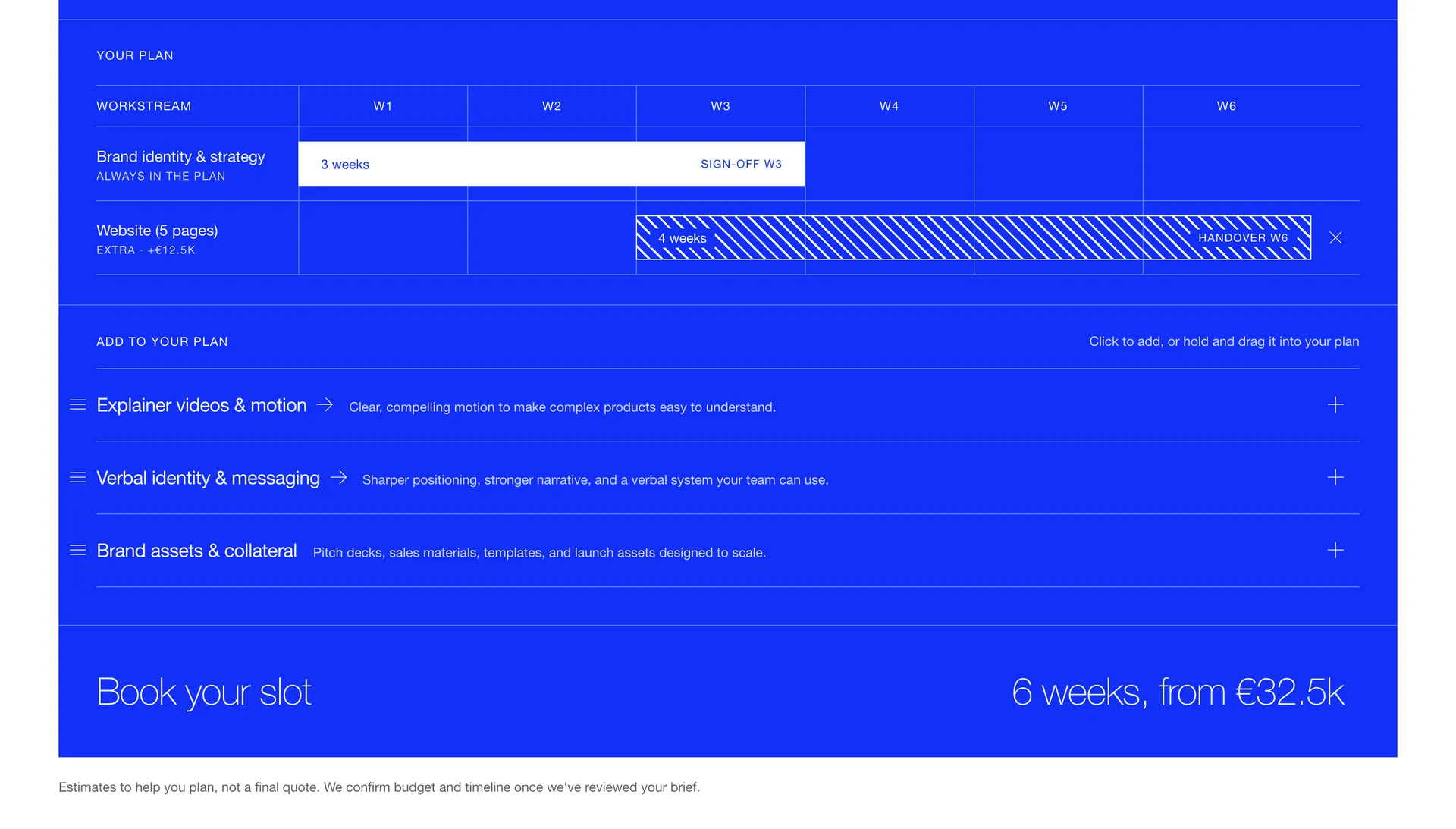
Every The Branx plan begins with a required brand identity purchase. You add a website, messaging, motion or assets in the price planner. The team then reviews your brief to confirm the budget and dates. On Featherless, they made a site for an open-model AI service. You supply content and product images. They design in Figma, build and test the site, then give you an editor guide and handover session.
At their starting prices, the required identity plus a five-page site comes to about USD 36,500. Estimated. Our brand projects usually run from $15,000 to $100,000 or more, and websites start from $15,000. Published, no currency stated. Set the two scopes side by side before comparing totals, because the site add-on alone leaves out the identity you must buy first.
Services. They name and design the brand, write the messaging and build the site, with motion and other assets available.
Price and timeline.
- Brand identity: from around USD 22,500, with three weeks listed by the vendor. Estimated price. Published timeline.
- Landing page: adds around USD 5,600 and about two weeks. Estimated price. Published timeline.
- Five-page website: an addition of around USD 14,000, and the build takes about four weeks. Estimated price. Published timeline.
- Ten-page website: from around USD 24,700 as an addition, over about six weeks. Estimated price. Published timeline.
The planner shows the selected brand and five-page site plan taking six weeks, with some work in parallel. Published. It labels the total an estimate, not a final quote, and the team confirms price and dates after reading your brief.
What clients say. 5.0/5 from 37 Clutch reviews. “They quickly grasped not just what we do, but where we’re heading as a company.” Digital Marketing & Content Specialist, SaaS Company, Clutch, 5.0/5, 26 February 2026.
Pros. The planner itemises additions against the required identity base, helping you budget each part. An editor guide and handover session also prepare staff to update the completed site.
Cons. Identity is compulsory, including for a website enquiry. Your staff supply content and product images.
7. Lexicon Branding: best for the company name itself
Naming is Lexicon Branding’s specialist assignment for products, services and companies. Their Vercel case describes changing Zeit’s name to suit a developer platform. The team uses customer research, language checks and trademark screening to assess names. Brand architecture helps set how names relate across a business.
Services. Their naming team researches and checks names, including language and trademark screening and the relationships between brands.
Price and timeline. The naming fee and project length are absent from their home and case pages, and Clutch leaves the minimum undisclosed. Not published.
What clients say. 5.0/5 from 20 Clutch reviews. “We were all impressed by the depth of insight into the science of naming from really, every angle.” VP of Product & Design, Healthcare Company, Clutch, 5.0/5, 7 June 2021.
Pros. Customer and language research test names against the intended audience and markets. Trademark screening adds a further check before identity design. The separate naming assignment lets your team approve candidates first.
Cons. Identity and website delivery need another engagement after naming. Lexicon’s fee and duration are not published.
8. Bop Design: best for B2B branding implemented in WordPress
For a WordPress rebrand, Bop Design handles the site from discovery and concepts through content, development and launch. The web team uses WordPress only, with branding and copy in the same service. Their work includes Pivotree in software and technology. They also sell ongoing marketing for content and campaigns after the site is built.
Services. Their web team designs the brand, writes the content and builds the WordPress site, with ongoing marketing available.
Price and timeline. Bop lists a starting price of USD 25,000 and an average of about USD 45,000 for B2B web design. Published. A site with twenty standard pages takes about sixteen to twenty weeks to design and launch. Published. These are website figures. Ask for a separate scope for a new brand.
What clients say. 5.0/5 from 127 Clutch reviews. “They understood the challenges our company faced with our long lead and complex B2B sales process.” VP of Communications, Conrac Solutions, Clutch, 5.0/5, 7 July 2026.
Pros. Bop handles website content and implementation in the same assignment, reducing separate supplier management. Ongoing marketing is available afterwards as a further purchase when your team needs post-launch support.
Cons. WordPress is the only build platform. The published figures cover the website, so a new brand needs its own scope.
7. How we picked these studios
We checked leadership research, naming and brand architecture against each studio’s services. Build and handover details established who implements the website and who maintains it. Published packages and directory figures supplied the budget signals. The fit labels reflect the B2B and technology work in each portfolio. Refract wrote this comparison and placed its own entry first, judged on the same checks. No studio paid to appear.
We left production subscriptions out because ongoing assets don’t replace a brand strategy project. Naming has a place on the list because Focus Lab excludes company names.
8. Brand architecture for B2B companies: one master brand, endorsed products or separate brands
Brand architecture defines how customers recognise the relationship between your company and its products. Before a rebrand, list every name customers already see, including acquired businesses and product names. The design team needs to understand which names refer to a business, which refer to an offering and which are due to disappear.
A master brand puts the company name across the portfolio. Product names identify the offering within that shared identity. This can suit related products sold through one customer relationship. Set rules that a future product can use too.
An endorsed product has an identity of its own with a visible link to the parent company. That link can retain an acquired product’s recognition while introducing its new parent company. Decide where the endorsement must appear, including on a product page and in material your sales team sends customers.
Separate brands keep distinct identities for different businesses or offerings. Different audiences or existing recognition can justify them. Each one needs its own guidance and people to look after it once the studio hands over.
We begin a brand brief by clarifying how the business explains its offerings. Bring the existing product names and examples of where customers see them. Record which existing names change and who approves exceptions as new products join the portfolio.
9. When Focus Lab is still the right choice
Structural Rebrand includes merger work and cross-team agreement, so Focus Lab remains our pick for that brief. It needs a broader arrangement than our launch team provides.
Weekly sessions and recorded Friday walkthroughs give staff a set review process when you can consolidate feedback.
Their retainers cover ongoing design and brand support after launch, and you can keep that support if it already fits your team’s needs.
10. Plan your B2B brand project with us
For an acquired brand, a specialist can handle the structural work while your current team implements it. Focus Lab, Motto and Koto cover different parts of that brief.
If the job is a brand, a website or both as one launch, tell us about it and we’ll set the scope together. We build the site for the way your team edits. Our services cover the brand, product and web work we do.
11. Questions
Yes. Tell the designers which name and logo elements customers recognise and which parts still fit the business. The team can then plan the other changes around those constraints.
One accountable approver should represent the business in the final brand decision. Collect sales and marketing comments into one response, distinguishing errors from preferences. If each team holds its own right to approve, the designers receive conflicting requests.
Start with the approved brand material and access to the current website. The new agency also needs the working files behind that material. Include the research and any rejected ideas with the reasons they were dropped. List unfinished work, current suppliers and the tasks your own staff will keep.
The signed agreement decides which rights you receive. Ask the studio to identify the source files included in the handover and their permitted uses. Your contract should also cover licences for fonts, images and other assets, and a naming brief should state the checks included. The public service pages don’t establish ownership terms, so read each team’s proposal.
Give existing customers a clear explanation of the name change before updating the places they use to reach you. Put the website pages, customer messages and sales materials in the launch scope. Name an internal team to complete any phased updates after the designers finish.
Written on by
 Refract