Clay Design Agency Alternatives (2027): 6 Studios and Services for Tech Startups, With Real Prices
Compare six Clay design agency alternatives for tech startups, with product and website scopes, published prices and reasons to keep Clay.

1. Quick summary
Clay combines brand, product and website work, but a first interface or a site-only brief can prompt a search for another model. For a scoped interface, our pick is Refract. Ramotion offers separately priced phases, and MetaLab can handle an application build. We design first interfaces and redesigns in Figma from your team’s research and limits on the build. Brand or site work can be added when needed. If the interface keeps changing after launch, an embedded team works with you by the month.
We assessed six alternatives for design scope, build and ongoing support, using service, package, work and review pages read on 3 October 2026. Clutch’s minimum project amounts come from the studios’ profiles, not proposals for your brief. We kept design-only fees apart from engineering charges.
| Pick | Best for |
|---|---|
| Refract (us) | A first product interface or a scoped redesign |
| Ramotion | Separately priced brand and product programmes |
| MetaLab | An application with brand and engineering alongside |
Keep Clay on the shortlist when you need enterprise software, brand and a broad range of content.
2. Why listen to us
The Managed project is an example of our product design at Refract: a compliance module, renter onboarding and a white-label theme. At Atrium, we designed inbox and onboarding flows, mobile screens and micro-interactions within the client’s engineering workflow. Those briefs required us to scope interface work with the people building it.
Refract has killed it again. We call your team FEDEX because you always deliver!!
3. What Clay costs in 2027
Clay’s own pages give no project price or hourly figure, and say they use a blended rate. The team sends a quote after talks about the brief. Not published. The quote includes the scope, cost and timeline. They use three models:
- Time and materials: billing for the work as the scope changes. The rate comes in the quote.
- Fixed fee: a price agreed for the scope.
- Retainer: ongoing support, with scope and terms set in the quote.
The Clay profile gives a USD 50,000+ project minimum, at USD 150–USD 199 an hour. Directory, Clutch. It scores 4.8/5 from 32 Clutch reviews. Directory, Clutch. “They delivered every milestone on time and proactively tracked progress against our agreed-upon timeline and budget.” President, Software Development Company, 5/5 on Clutch, 24 July 2025. That review covers one client’s budget tracking. Ask Clay to list research, design, build and content work separately in your quote.
Their startup FAQ includes SaaS brand, product and site changes for enterprise buyers. For a design-only commission elsewhere, your engineers usually build the application.
4. Why people leave Clay
Clay’s price arrives after discovery conversations
Ramotion’s packages give you initial fees and exclusions before discovery. Our Ramotion alternatives comparison examines the separate product and website charges.
One discipline covers the whole brief
Your brief may be limited to an interface redesign or a website using the existing identity. Junca publishes a starting price for a focused Framer site. Clay also accepts scoped work, so a narrow brief alone is no reason to exclude them.
You want new pages on a recurring basis
For new pages and live-site changes, Growmodo’s per-talent fee includes project management and QA. Clay quotes retainer support too. Both depend on your briefs and feedback.
5. The 6 best Clay design agency alternatives for tech startups: full comparison
| Option | Best for | Price signal | Timeline signal |
|---|---|---|---|
| Clay | Brand, product, development and content in one brief | Custom proposal after discovery, no price on their own site, Clutch minimum USD 50,000+ Directory, Clutch | Set in the proposal Not published |
| Refract (us) | A first product interface or a scoped redesign | From $10,000 a month, no currency stated Published | Focused work 4–6 weeks, full engagement 10–16 Published |
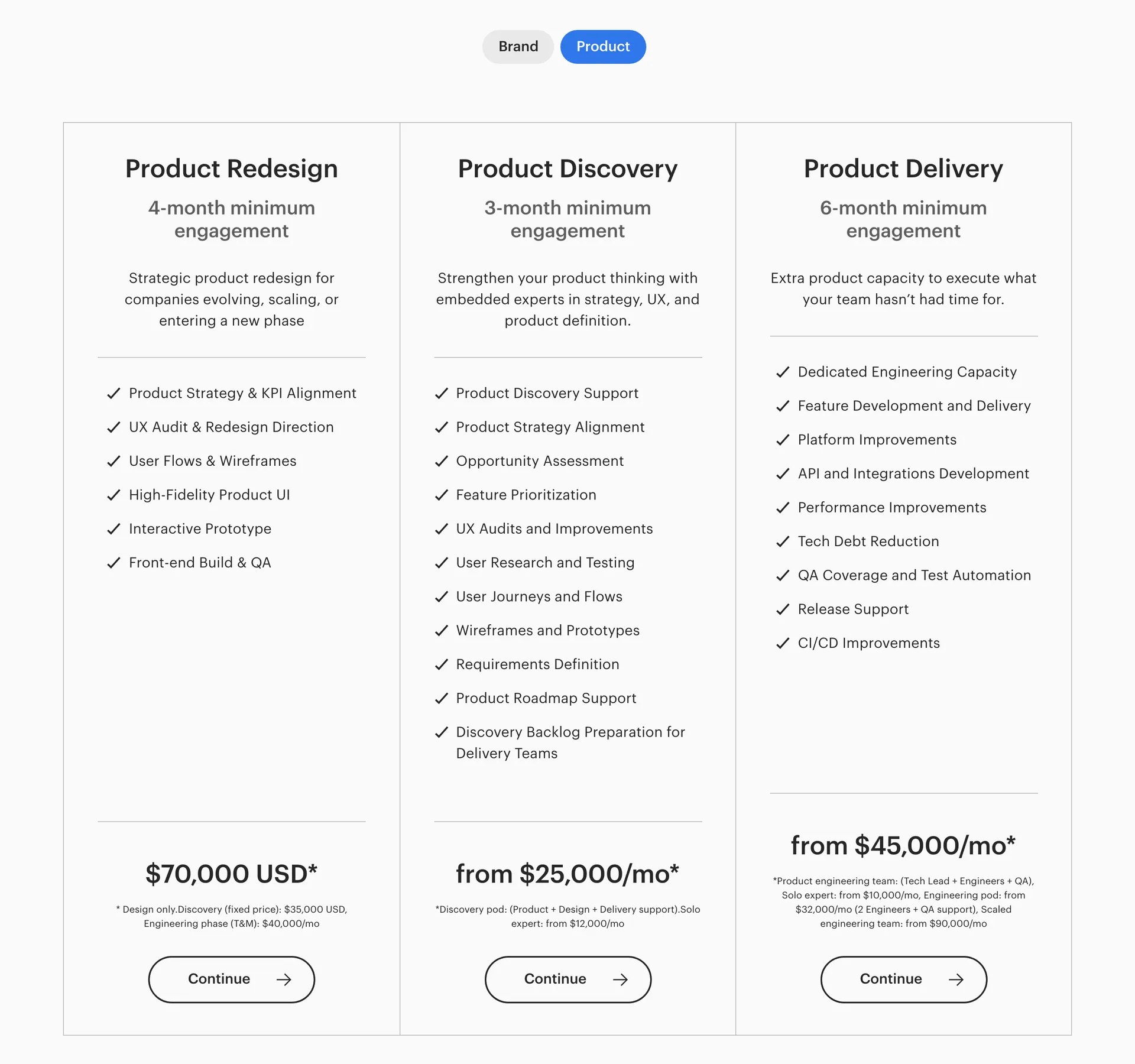
| Ramotion | Separately priced brand and product programmes | Product Redesign USD 70,000, design only · brand packages USD 60,000/85,000, website extra Published | Product Redesign four-month minimum · brand cards 3.5 months Published |
| MetaLab | An application with brand and engineering alongside | No price on their own pages, Clutch minimum USD 100,000+ Directory, Clutch | No public duration Not published |
| Edition | Discovery followed by a software build | Project quote, no public amount Not published | Project-based typically 1–3 months · team-based typically 3+ months Published |
| Junca Studio | A focused website after brand decisions | Around USD 6,000 for focused Framer sites · USD 20,000+ for larger scopes Published | Marketing site usually 4–6 weeks · expanded scope 8–12 weeks Published |
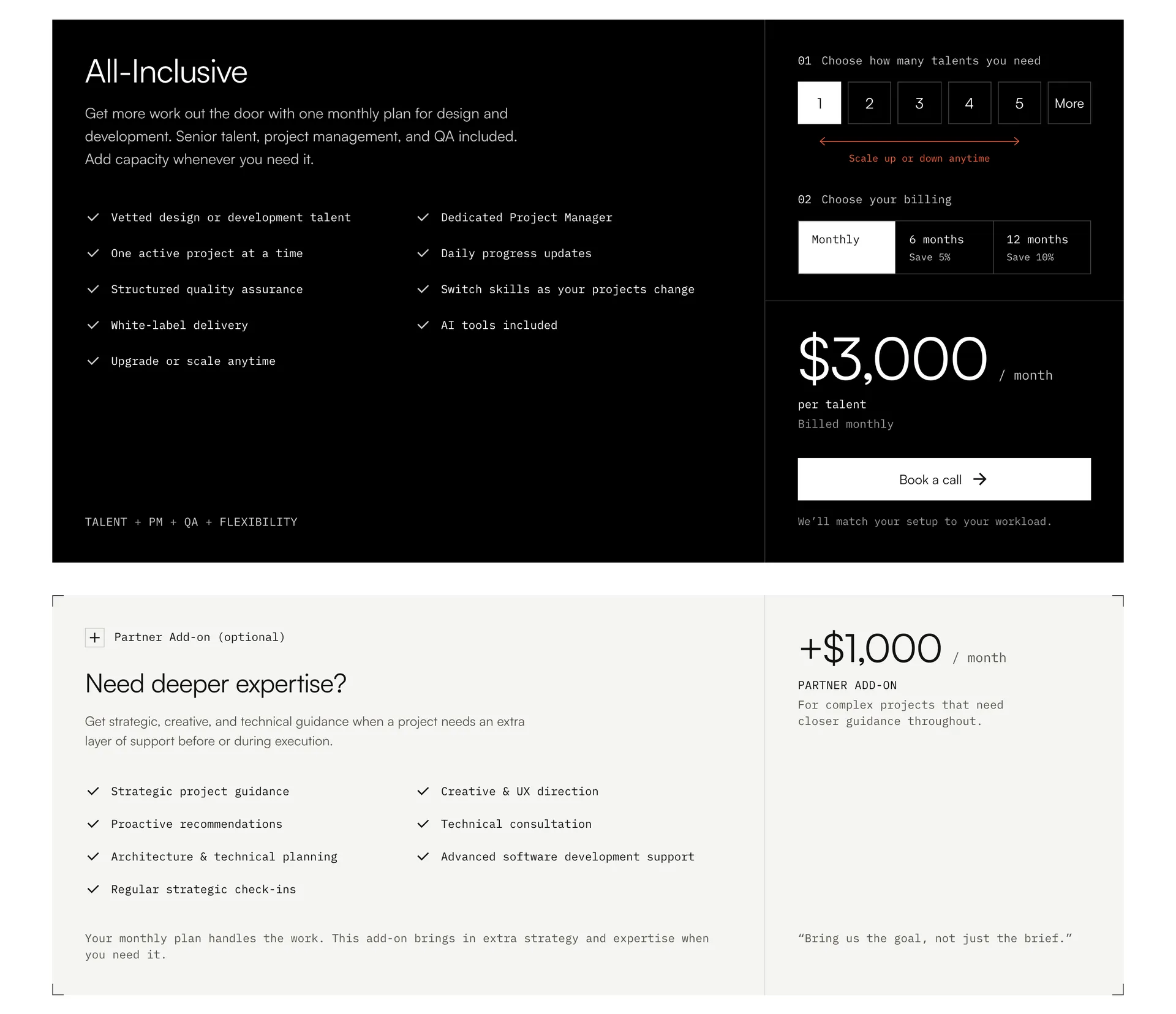
| Growmodo | Ongoing website design and development | USD 3,000/month per talent · optional guidance USD 1,000/month Published | First-version estimates vary by request Published |
1. Refract: best for a first product interface or a scoped redesign
Our interface projects cover first screens for pre-seed teams and complete product redesigns. We work in Figma with your product team, using their existing research. For brand or site work too, our design, product and web services can extend the brief. An embedded monthly team supports ongoing work.
Services. Product research, screens and prototypes are part of our Figma work with your team. The brief can include shared components, the identity or a website build with CMS handover.
Price and timeline. Product design starts from $10,000 a month. The journeys in scope, research access and limits on the build set the final figure, which we agree before starting. Published, no currency stated. Focused product work usually takes four to six weeks, a full engagement ten to sixteen. Published.
What clients say. “No really, I never thought we could ever have such an awesome website. I would see other brands and go, how did they do that. Now I know how: work with an awesome agency like Refract.” Jevon, Founder and CEO, Keeyu.
Pros. A standalone interface project lets your engineers implement new screens within the existing brand. We can include a website build and CMS handover in the same brief, giving your launch team a way to publish pages afterwards.
Cons. We’re a small team, and we agree parallel work within the scope. A programme spanning several approval groups gets a separate scope and capacity plan.
Discuss your product or website brief with us
2. Ramotion: best for separately priced brand and product programmes
The package route at Ramotion separates discovery, interface redesign and engineering fees. Brand packages charge extra for website work. Later updates use time and materials or maintenance support.
Services. Their team researches and prototypes the product, designs interfaces and shared components, and can build the software in a separately priced engineering phase. Brand and website work have their own scopes.
Price and timeline.
- Product Redesign: USD 70,000 for design only, with a four-month minimum. The footnote lists fixed-price discovery at USD 35,000 and an engineering phase at USD 40,000/month. Published.
- Brand Creation: branding alone is USD 60,000, and a website of 1–5 pages is priced separately at USD 25,000–USD 60,000. The package card gives 3.5 months. Published.
- Brand Redesign: the card gives 3.5 months for USD 85,000 of branding only. Website design of about seven pages adds USD 45,000, and website development depends on the design. Published.
What clients say. 4.9/5 from 29 Clutch reviews. Directory, Clutch. “I was impressed with their brand personality exercises and visual design process.” Director of Growth, Murf AI, 4/5 on Clutch, 9 May 2025.
Pros. The cards separate brand, interface design and engineering costs, helping you decide which phase to commission. After-launch support can cover new pages and features, extending the engagement beyond the original deliverables.
Cons. Product Redesign has a four-month minimum, long for a short interface task. Engineering is a separate charge on top of the design fee.
3. MetaLab: best for an application with brand and engineering alongside
Brand work for Suno grew into a Full Build project with MetaLab, covering product design and engineering. Shared component libraries supported further work by the client’s team.
Services. MetaLab designs the brand and product interface and builds the application, with shared component libraries the client team can extend.
Price and timeline. MetaLab’s own-site pages give no price or standard timeline. Not published. Minimum project size on Clutch: USD 100,000+. Directory, Clutch. Ask MetaLab to identify the features and build included in your proposal.
Pros. A full-build commission can include the software implementation, reducing separate design and engineering contracts. Shared component libraries documented in their work give an in-house team material to extend after delivery.
Cons. The USD 100,000+ directory minimum is a large first commitment for a startup interface. Directory, Clutch. Their own pages give no standard delivery period.
4. Edition: best for discovery followed by a software build
Edition begins startup work with discovery, market tests and a prototype for the MVP, the product’s first version. Project-based work has a defined delivery, while a team project releases work from your backlog in stages. Their portfolio includes Kernel’s investment platform and website.
Services. They research and prototype the product before building the front end, back end and API integrations, with QA and support. The brief can also include the brand identity and website.
Price and timeline. Edition quotes the project with no public fee. Not published. Their startup page puts project-based work at typically 1–3 months, and team-based work is typically 3+ months. Published. Ask Edition for a build date when you send your scope.
Pros. Discovery and MVP scoping can precede development within one commission, connecting product decisions to the build. A team-based engagement supports staged releases from a changing backlog.
Cons. Edition quotes only after scoping, with no published package to estimate from. Team-based work typically runs three months or more. Published.
5. Junca Studio: best for a focused website after brand decisions
A shared Notion workspace tracks Junca’s site milestones after the opening call. You speak directly with the designers and developers. Their tech websites include BotBlox, Hylight and Skipper NDT. Framer builds use its CMS, and custom sites can use Sanity.
Services. You work directly with the designers and developers building the site in Framer, Astro or Next.js. They can include visual identity, motion and interactive 3D, and train your team to use the CMS at launch.
Price and timeline. Their home FAQ prices focused Framer websites from around USD 6,000. Larger projects with branding, custom 3D and copywriting usually reach USD 20,000 or more. Published. A marketing site usually takes 4–6 weeks after brief approval, with branding, 3D or custom animation taking 8–12 weeks. Published.
Pros. Direct access to designers and developers keeps site decisions close to implementation. CMS training supports your team’s editing after launch, with visual or custom builds available around that workflow.
Cons. The starting fee covers a focused Framer website, and branding, 3D or copywriting move the budget up. Their scope stops at the website, so it does not replace an application build.
6. Growmodo: best for ongoing website design and development
For monthly site production, Growmodo assigns each request through a project manager, with daily updates and QA. A talent handles one active project, moving on when it finishes or waits for input. Additional talent enables parallel work. The catalogue covers website pages, Webflow and Framer builds, and product UI.
Services. A project manager assigns your website, interface and marketing requests to the right talent and oversees QA. The optional Partner Add-on provides strategic, creative and technical guidance.
Price and timeline.
- All-Inclusive: USD 3,000/month per talent, with project management and QA. Published.
- Partner Add-on: an optional USD 1,000/month for additional guidance. Published.
The service page’s time estimates apply to the first version. They depend on a clear brief and prompt feedback. They give no end date for a whole redesign.
We calculate five paid months of one talent at USD 3,000/month as USD 15,000. Estimated, from the published peer prices. Our websites start from $15,000, with no currency stated on our pricing page. That fee buys a finished site, while the monthly service buys capacity, so more talent and the add-on raise its spend.
What clients say. 4.8/5 from 86 Trustpilot reviews. Directory, Trustpilot. “It took a little time in the beginning to fully understand their workflow and how the scope of tasks works, but after about a month it became much clearer.” Trustpilot reviewer, 5/5, 11 March 2026.
Pros. Design and development requests can share a subscription, letting your team adjust the backlog as site work changes. Project management and QA are included, and extra talent adds parallel capacity.
Cons. One talent handles one active project at a time, so parallel design and build work needs a second seat. Strategic, creative and technical guidance is an optional USD 1,000 a month on top. Published.
6. How we picked these alternatives
- Product responsibility. We checked design outputs and implementation scope to establish the work your engineers would own.
- Engagement model. Packages, projects and monthly support were assessed by their inclusions and feedback process.
- Website handover. Site builds, CMS setup and training informed the website slots.
- Price scope. Exclusions and capacity limits stayed beside the amounts.
- Client evidence. Own-site projects supported each entry’s stated use.
- Our own entry. We wrote this comparison and put Refract first among the alternatives. No studio paid to be included.
Graphics-only subscriptions and the unrelated Clay data tool don’t replace this brief. For a company-wide position or identity change, our Focus Lab alternatives page covers brand agencies. Ongoing interface work has its own AI product design agency comparison.
7. What your engineers need from a product design handover
Your engineers should be able to follow each flow from the design handover. Record the choices behind it. Agree the delivery format with them while the studio is still designing. Map the new screens to the features in your backlog, and mark any research questions that remain open. Developers can then price the build against the version your product owner signed off.
Include the states between the main screens. An engineer needs to know how a form behaves during submission, after an error and when the user lacks permission. Empty lists, loading states and long content also need designs or written behaviour. For mobile layouts, note where controls move or disappear and how users reach the same actions. These choices affect build costs and the checks for finished work.
Shared components need names and rules for each version. Figma supports components, variables and shared libraries, while Dev Mode provides inspection, measurements and asset export. Published, in Figma’s documentation. Check that the engineers have access to the required files and features. Ask the studio to mark reused code components and designs needing new ones. A prototype shows the flow, but developers also need the rules behind interactions that it doesn’t demonstrate.
Keep the approved version clearly labelled. Note design changes against each feature and name who settles conflicting comments. Agree how developers raise questions during the build and whether the studio reviews the finished screens. Use the approved screens and behaviour notes for that review. Record faults apart from new requests.
We design product interfaces in Figma with the client’s product team, and build the design system in code when that is in scope. We use your current components and account for limits on the build. Include the handover notes and review of the build in your brief. Both teams can then plan for that work.
8. When Clay is still the right choice
Clay’s enterprise FAQ says they work as a unit inside the client’s business and build design systems for the in-house team. If you run a legacy enterprise app with several user groups and teams signing off the work, keep Clay on the list. A programme at that scale sits outside one scoped engagement with our small team.
Clay’s services also include photography, video, illustration and 3D alongside design and development. If the product and brand need that range of content, splitting it across suppliers means your team coordinates them.
You may also prefer to stay if Clay’s fixed-fee or retainer proposal covers the work you need. Compare the included work before treating another package as a saving. A new studio will need a fresh brief and review process.
9. Work with us
We can design first screens or new flows around your current product and brand when your engineers need that help. A website can be added where the launch requires it. Read how our product, brand and website work runs, then send the brief, current designs and intended launch.
10. Questions
Send the new studio the approved designs, open decisions and current build, with source-file access. Ask them to check the work still to do, and mark which concepts are signed off and which are tests. Read the existing contract’s termination and handover terms too: the studio’s stated model alone doesn’t set them.
Your signed agreement should specify the rights you receive and how the studio transfers the files. Fonts, images and software may have separate licence terms. Ask whether you can modify the work and commission another supplier to develop it after the project ends.
Send the brief, known user problems, past research and current screens. Give the studio access to decision makers and explain limits on the build. Name a product owner to bring feedback together and settle conflicting requests. Ramotion’s startup UX page asks for a product owner to join design syncs and provide timely feedback.
Ask the studio to price the work to redo as a scope change. Ramotion’s package FAQ says a new direction once the build has started means restarting that phase or switching to time and materials. Document the approval stage and revision allowance in your own agreement, and keep the terms specific to that studio.
List bug fixes, new features and routine site changes in the support terms. Agree who handles the CMS, hosting accounts and release process, plus any ongoing fee. Ramotion describes maintenance retainers and time-and-materials support after a package. Junca includes CMS training and advertises availability afterwards. Ask them to confirm any support fee and duration.
Yes, with one owner for the shared identity. Agree how the site uses product screens and who updates the shared assets. Give the web team the brand files too. Each contract should state the review process and the choices already signed off.
Written on by
 Refract