Ramotion Alternatives (2027): 7 Studios for Funded Tech Companies, With Real Prices
Seven Ramotion alternatives for funded tech companies, with package costs, website extras and the scope each studio takes on for brand or product work.

1. Quick summary
Ramotion’s separate brand, site and product fees can prompt a search for a smaller launch scope. Three studios answer that search: Refract for the smaller launch, Clay for launch content and Eleken for ongoing SaaS interface work. We price the identity, site or interface around your brief, with several disciplines included when the launch needs them. For ongoing work, our monthly team works inside your sprints, with the people and terms agreed upfront.
The seven alternatives cover brand launches, website builds and ongoing product design. We read service, package, project and Clutch pages on 3 October 2026, using each profile’s minimum project size as a directory signal. GBP conversions use the ECB’s 2 October rates, the latest available at that check, and are labelled Estimated.
| Pick | Best for |
|---|---|
| Refract (us) | A scoped brand, product or website launch |
| Clay | Brand, product and content in one agency brief |
| Eleken | Ongoing SaaS product UI and a design system |
Stay with Ramotion when you need ongoing brand support alongside a product engineering team.
2. Why listen to us
Our brand and website work gives us direct experience of the launch scopes being compared. The Kaizn project combined identity, website and sales material. For Managed, we designed a marketing site and product interfaces, including compliance screens and renter signup.
We love our new look and website. Thanks so much, your team smashed it.
3. What Ramotion costs
Ramotion’s startup packages use Slack, weekly Zoom calls and Loom updates, with a project manager as the main contact. Designers and developers join as needed. After launch, new work is billed on time and materials or through monthly maintenance.
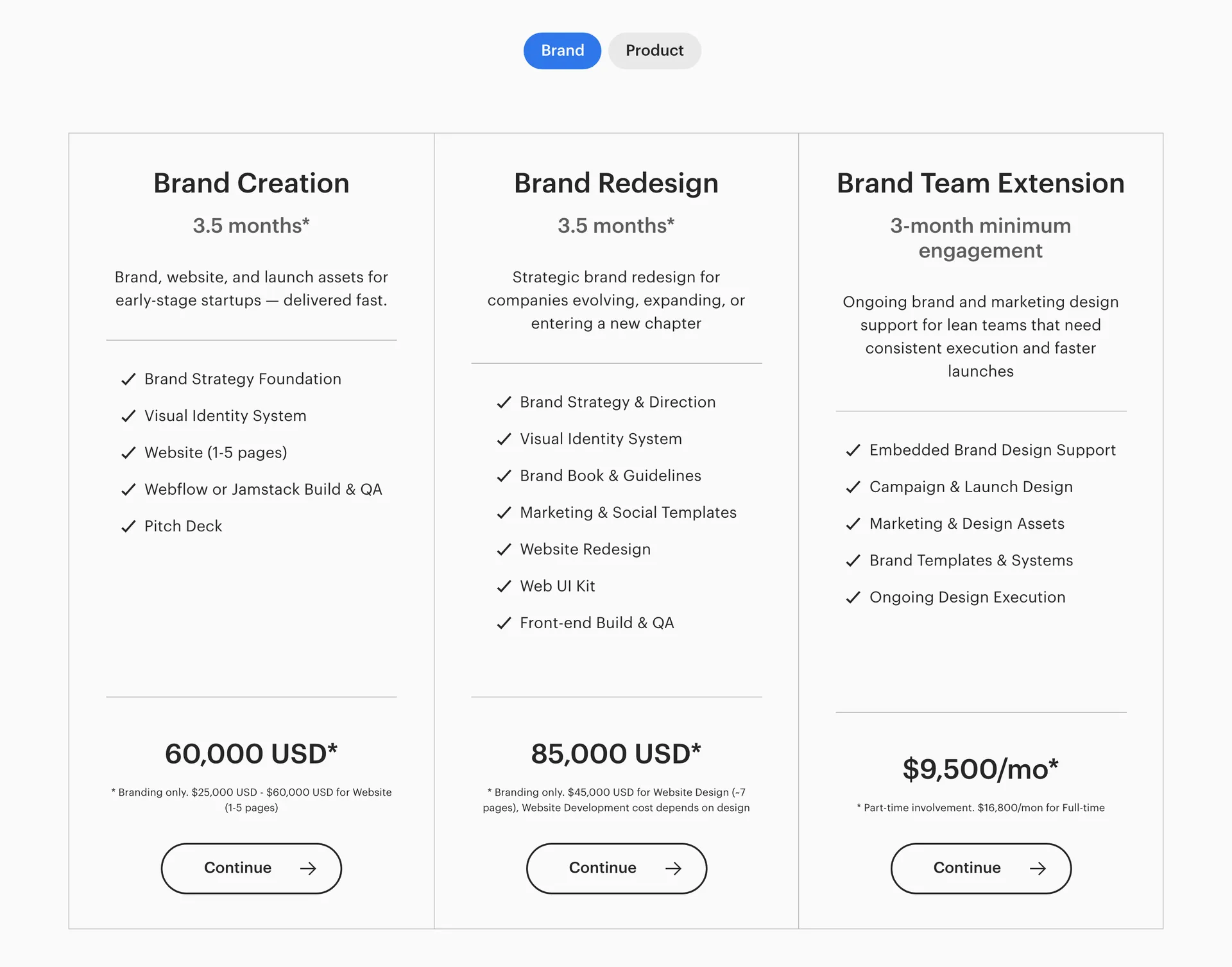
- Brand Creation: USD 60,000 for branding only, on a 3.5-month package timeline. The card lists strategy, identity, a site, build, QA and a pitch deck. The footnote adds USD 25,000–60,000 for a site of one to five pages. Published.
- Brand Redesign: branding alone costs USD 85,000 over 3.5 months. Site design for roughly seven pages adds USD 45,000, and the site build is priced from that design. Published.
- Brand Team Extension: part-time involvement is USD 9,500/month and full-time is USD 16,800/month, with a three-month minimum. The fee covers brand assets, campaigns and templates. Published.
- Product Redesign: USD 70,000 covers design only, with a four-month minimum engagement. In the footnote, discovery is USD 35,000 and engineering is USD 40,000/month on time and materials. Published.
- Product Discovery: a discovery pod starts at USD 25,000/month with a three-month minimum, and a solo expert at USD 12,000/month. The scope covers research, flows, prototypes and a product plan. Published.
- Product Delivery: the product engineering team costs from USD 45,000/month on a six-month minimum. The card also lists a solo expert from USD 10,000/month and an engineering pod from USD 32,000/month. A scaled team starts at USD 90,000/month. Published.
We calculate Brand Creation plus the website allowance at USD 85,000–120,000. Estimated from Published figures. The card lists a Webflow or Jamstack build and QA, so ask Ramotion which site work that fee covers. Brand Redesign plus website design comes to USD 130,000 before website development. Estimated from Published figures. Product design and code are scoped separately, and neither sum prices a combined brand, website and product redesign.
The 3.5-month brand timeline leaves the added site’s finish date unconfirmed. Ask Ramotion to date each part of a combined quote.
4. Why people leave Ramotion
The website sits on top of the brand fee
The brand cards include a website in the scope list, with an additional fee in each footnote. You may need fewer assets, or only a new site using your existing identity.
Ramotion gives product work its own fees and terms
Ramotion prices discovery, interface design and engineering as distinct commitments. Your team may need ongoing UI tasks without buying the wider build and testing scope.
Your team may want to work another way
Ramotion routes work through a project manager. Some teams would rather talk to the designer directly, or buy a short fixed sprint instead of a 3.5-month package.
5. The 7 best Ramotion alternatives for funded tech companies: full comparison
| Studio | Best for | Price signal | Timeline signal |
|---|---|---|---|
| Ramotion | Brand and product programmes, including engineering capacity | Brand Creation USD 60,000, website USD 25,000–60,000 extra. Published. | Brand package 3.5 months, added website completion unconfirmed. Published. |
| Refract (us) | A scoped brand, product or website launch | Brand projects usually $15,000 to $100,000 or more · websites from $15,000 · team $10,000–$30,000/month Published, no currency stated | Timeline agreed by scope. Published. |
| Clay | Brand, product and content in one agency brief | No price on its own site, Clutch minimum USD 50,000+. Directory, Clutch. | Timeline provided in the proposal. Not published. |
| Eleken | Ongoing SaaS product UI and a design system | USD 4,599/month part-time, USD 6,599/month full-time. Published. | Two-month minimum, delivery depends on scope. Published. |
| basement | Identity and web work for a developer audience | No price on its own site, Clutch project minimum USD 10,000+. Directory, Clutch. | No public project duration. Not published. |
| Huemor | A marketing website without the product programme | Website from USD 25,000, most projects USD 50,000–100,000. Published. | SaaS redesign 12–16 weeks from kickoff to go-live. Published. |
| Overpass Studio | A recurring brand and website stream for sales-led B2B SaaS | One design stream about USD 5,200/month. Estimated conversion. | Three-month minimum, task updates every 48 hours. Published. |
| Foundation | A fixed-fee technology brand sprint | About USD 13,200 excluding VAT. Estimated conversion. | Ten working days. Published. |
1. Refract: best for a scoped brand, product or website launch
With your launch date in mind, we define the output and fee with your team. That work can be a brand, website or interface. At Atrium, our product design covered shared interface patterns, mobile layouts and interaction states within the client’s engineering workflow.
For ongoing work, our designers and engineers can join your sprints, working on your board and in your weekly reviews.
Services. See our services for identity, websites and product screens. For continuing work, a monthly team works inside your sprints.
Price and timeline. Brand projects usually run from $15,000 to $100,000 or more. Websites start from $15,000 and product design from $10,000 a month, and our monthly team runs $10,000 to $30,000 a month. Published, no currency stated. We agree the scope and price before work starts, and most websites take four to eight weeks.
What clients say. “Refract has killed it again. We call your team FEDEX because you always deliver!!” Rohith, COO, Managed.
Pros. We can develop the identity and its website or interface applications within one engagement. You can also hire us for one discipline alone. Our published prices give you a budget range before the scoping conversation.
Cons. A project ends at the agreed handover, and further design requests need a new scope or our monthly team.
Describe your launch or redesign.
2. Clay: best for brand, product and content in one agency brief
Clay designs your identity, product screens and website under one agency brief. They also build the code and create launch content. Discovery conversations lead to a quote under time and materials, fixed fee or retainer. Their scope includes research, design systems, copy, animation, photography and video. Their work includes designing and building Slack’s interactive demo experience.
Our Clay design agency alternatives comparison treats the interface and build as separate briefs.
Services. User research informs identity and interface design. Their website and software builds can include copy, animation, photography and video.
Price and timeline. Clay provides a cost and timeline after discovery. Clay’s own pages give no public package price. Not published. Clutch minimum: USD 50,000+, at USD 150–199 an hour. Directory, Clutch.
What clients say. 4.8/5 from 32 Clutch reviews. Directory, Clutch. “The refreshed brand system also brought a level of consistency and polish across all of our marketing and sales materials that we didn’t have before.” Associate Creative Director, Vestmark, 5/5 on Clutch, 7 April 2026.
Pros. Content production can be part of the design and build brief, giving you one supplier for launch assets. Clay’s project and retainer models allow a defined launch or further work as needs change.
Cons. Clay quotes only after discovery and publishes no standard timeline.
3. Eleken: best for ongoing SaaS product UI and a design system
Eleken assigns a UI/UX designer to work directly with your team. Their Head of Design oversees the work. Their redesign work starts with a UX audit and covers flows, navigation and interface work through handover. The monthly plan covers changes as your product grows. You set priorities with the designer instead of passing every request through a project manager.
For project and research-led options, or help defining a broader interface brief, see our AI product design shortlist.
Services. Your designer audits the SaaS interface and redesigns flows and screens. The Head of Design oversees this work and design systems.
Price and timeline.
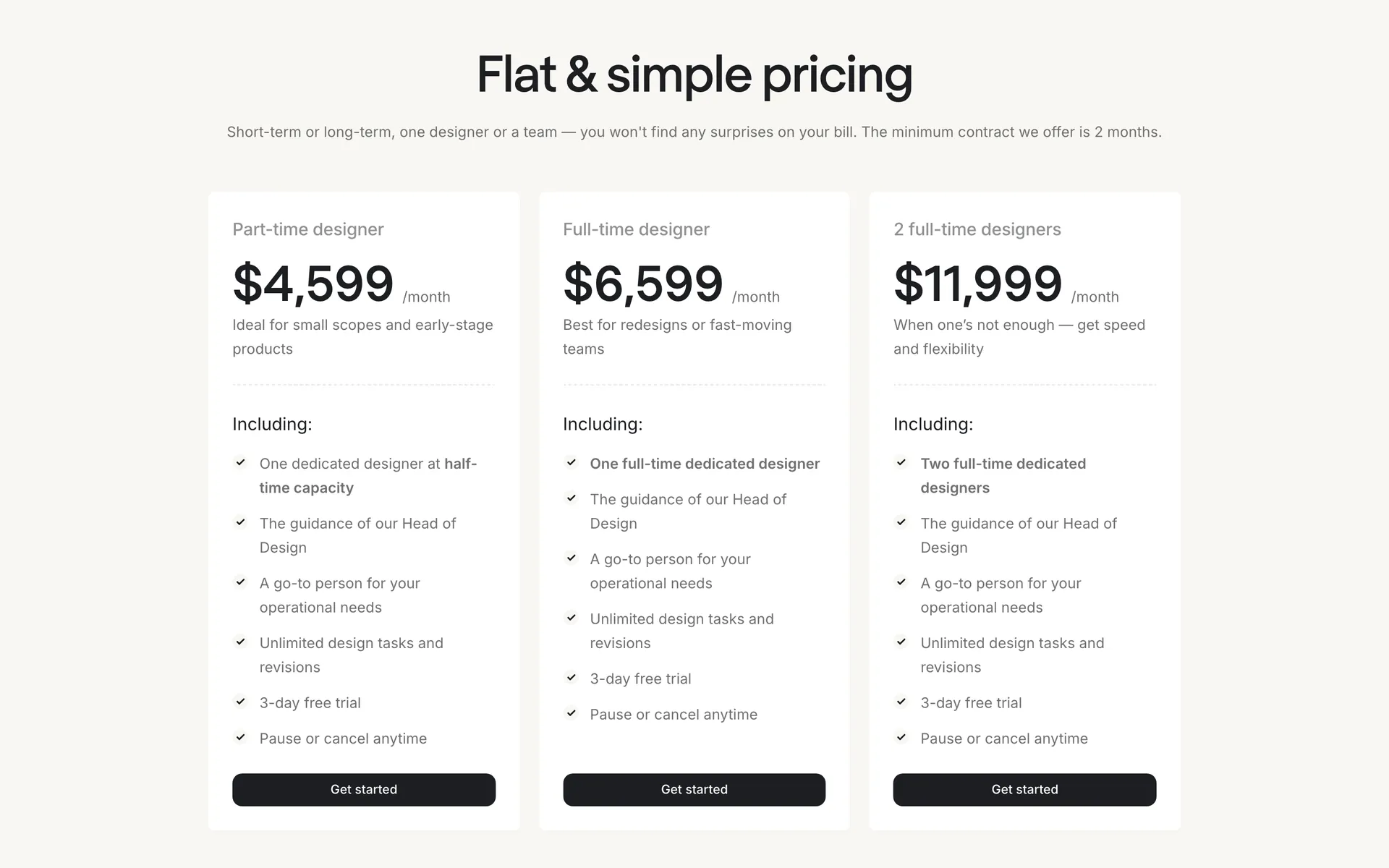
- Part-time designer: USD 4,599/month for one designer at half-time capacity. Published.
- Full-time designer: one full-time designer costs USD 6,599/month. Published.
- Two full-time designers: USD 11,999/month for both. Published.
Eleken’s pricing introduction states a two-month minimum, while the plan cards say “Pause or cancel anytime”. The redesign page says that flexibility starts after the minimum. The pricing FAQ asks for a month’s notice to cancel a monthly subscription. Published.
What clients say. 4.9/5 from 127 Clutch reviews. Directory, Clutch. “More visible senior oversight in day-to-day work would have been helpful at times, but when concerns were raised, they addressed them promptly and professionally.” Senior Product Designer, QbDVision, 5/5 on Clutch, 25 February 2026. The review covers a design system project.
Pros. The same subscription can cover an initial UX audit and later interface updates, keeping both in your design backlog. Direct designer contact lets your product team discuss flows without an intermediary.
Cons. Your team directs priorities and gives feedback throughout the project. Eleken excludes small logo or landing-page jobs. The two-month minimum comes before the pause-or-cancel option, and a monthly subscription needs a month’s notice to cancel. Published.
4. basement: best for identity and web work for a developer audience
basement designs identities for startups and larger firms and applies them to launch pages, full website redesigns and marketing assets. They also design physical event experiences. Working with Vercel’s team, they designed the Ship event website and stage, with projection mapping and collateral. The site handled event signups.
Services. They design the identity, website and marketing assets. An event brief can also include stage design and collateral.
Price and timeline. basement’s own pages give no public fee or delivery period. Not published. Clutch minimum: USD 10,000+, at USD 100–149 an hour, with no reviews yet. Directory, Clutch.
Pros. Their scope can include the event environment as well as its website, reducing separate briefs for a developer launch. Marketing assets can follow the initial identity, so the engagement can extend to its use in campaigns.
Cons. Neither a package fee nor a delivery period appears on their own pages. We found no product engineering in their public services, so an application build needs another supplier.
5. Huemor: best for a marketing website without the product programme
Huemor starts with a strategy session about your business, buyers and competitors. They plan and manage the website through launch. Their services cover redesign, development and branding on WordPress, HubSpot and Webflow. Ongoing website support is a separate service. The studio’s Boston Dynamics case shows a marketing website organised around the products and the buyer’s next step.
Services. Marketing sites use WordPress, HubSpot or Webflow, with branding available. Site support is sold separately.
Price and timeline.
- Website project: strategy, redesign and development start at USD 25,000, with most projects between USD 50,000 and 100,000. Published. Their SaaS page expects 12–16 weeks from kickoff to go-live. Published.
- Website support: ongoing work after launch is sold separately, from USD 2,500/month. Published.
What clients say. 4.8/5 from 72 Clutch reviews. Directory, Clutch. “If we modified our direction at any time, the team was agile and could accommodate. They did not add days or dollars to minor modifications to scope.” Executive, TeamDynamix, 5/5 on Clutch, 9 September 2024.
Pros. Their separate support service lets you commission later website changes after the redesign. WordPress, HubSpot and Webflow builds offer a choice around your existing site platform and editing workflow.
Cons. The offer centres on marketing sites, and an application redesign would be a separate brief. Website support is billed monthly after the project.
6. Overpass Studio: best for a recurring brand and website stream for sales-led B2B SaaS
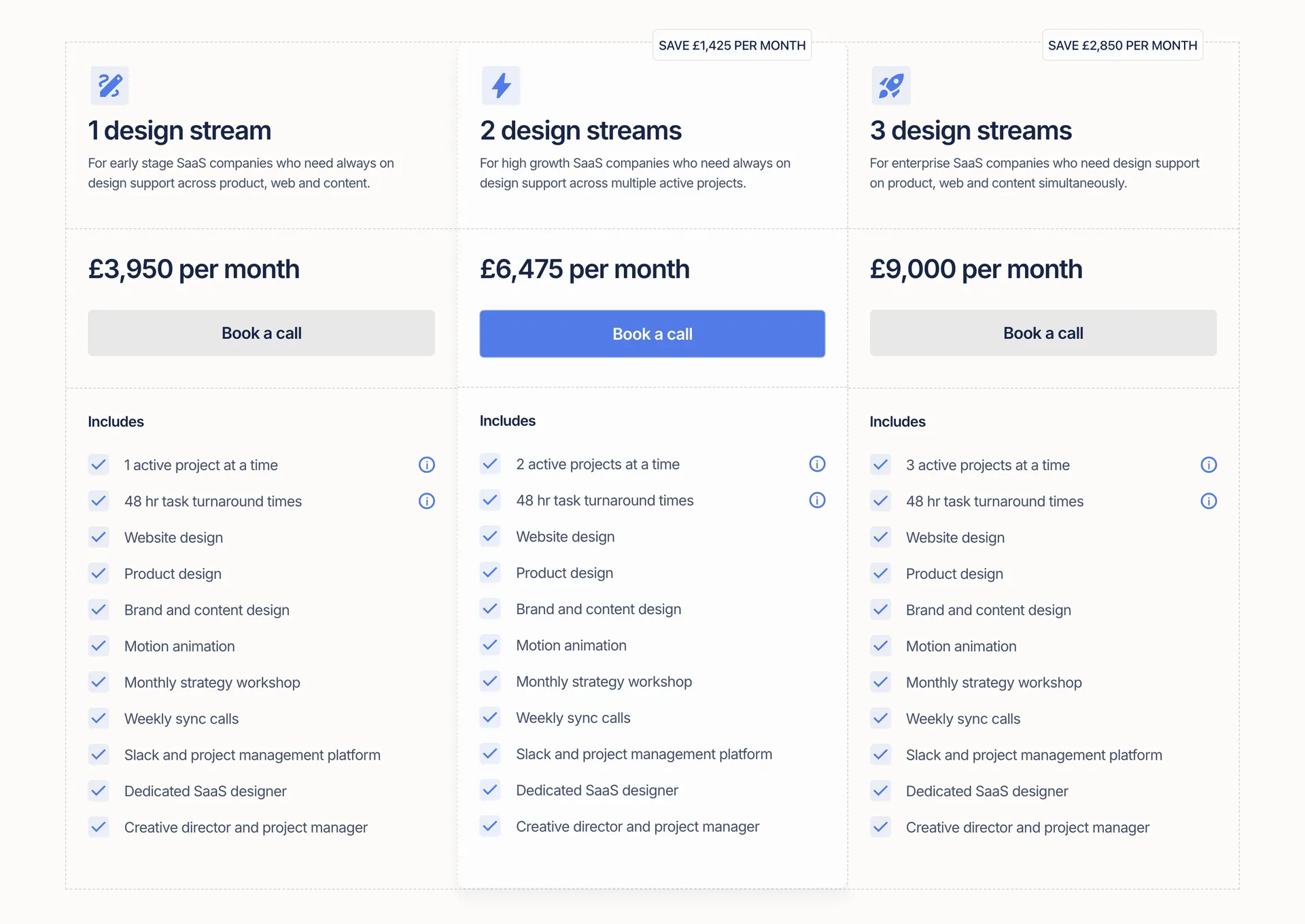
Overpass Studio sells monthly design streams across product, web and content. The team uses weekly calls, Slack and a task platform, with monthly strategy workshops. The pricing FAQ gives task updates every 48 hours. Output depends on clear briefs and feedback. Webflow development costs extra. Overpass also gives a fixed quote for a one-off website transformation or rebrand.
Services. Design streams cover brand, product, web and content. Sites include messaging and reusable page sections, with Webflow builds charged extra.
Price and timeline.
- One design stream: about USD 5,200/month. Estimated conversion.
- Two design streams: around USD 8,550/month. Estimated conversion.
- Three design streams: roughly USD 11,900/month. Estimated conversion.
- Webflow development: an add-on from about USD 1,270/month on top of design. Estimated conversion.
The partnership has a three-month minimum, and the 48-hour task updates give no finished-project deadline. Published.
Pros. A stream covers new brand assets and web pages as your sales programme changes. Monthly strategy workshops give your team recurring planning time, and reusable site sections support further page designs.
Cons. Webflow implementation is a paid add-on, so a design stream alone doesn’t deliver a built site. The three-month minimum is a long commitment for a single page request. Published.
7. Foundation: best for a fixed-fee technology brand sprint
Foundation’s Brand Sprint follows Define, Design and Deliver, with online workshops and feedback during the process. A creative partner leads the project. The output includes strategy and messaging, a visual identity, presentation and social templates, and a single-page Squarespace website. Their wider brand work includes Envisics and Trustonic.
Services. A creative partner leads the workshops and design feedback. You get strategy, messaging, an identity, slide and social templates, and a single-page Squarespace website.
Price and timeline. The fixed fee converts to about USD 13,200 excluding VAT. Estimated conversion. Half is paid before the workshop and half at handover. Delivery takes ten consecutive working days. Published. Domain registration, Squarespace and Canva Pro subscriptions are the client’s responsibility.
What clients say. 5.0/5 from 12 Clutch reviews. Directory, Clutch.
Pros. The sprint fixes the deliverables and payment stages in advance. Design rights transfer at completion, so your team can reuse the finished identity.
Cons. Naming is excluded, and the included website is a single page.
6. How we picked these studios
Scope overlap. Each entry replaces a specific part of Ramotion’s brand, web or product remit, supported by service and project pages.
Working arrangement. We checked how briefs and feedback reach the studio, including direct designer contact and managed design streams.
Price and handover. Package exclusions, commitments and file rights informed the comparison. Our B2B SaaS website agency comparison examines ongoing marketing-site needs.
Project evidence. We required tech work on the studio’s own pages and attributed review scores to Clutch. Ad and traffic services without relevant design scope were excluded.
Our own entry. Refract is first because this is our page. The other studios were not contacted, and nobody paid to be listed.
7. Who builds the website after a brand package: design, development, QA and the CMS handover
Before you approve a brand package, name who builds the live website. Choose someone from your team to sign it off. The identity files guide the visual work. Your website brief also needs page designs, a working build and a publishing workflow. Assign each output to the agency, your developers or another supplier so a handover between them has an agreed recipient.
For design, request responsive layouts and the behaviour of navigation, forms and animation. A developer working from desktop screens alone still has to decide how those elements adapt. Include final copy and image assets in the handover, with a record of any licences your company needs. Agree who answers questions during development and whether design review of the build is included.
After development, name who tests forms, mobile layouts and links. Agree how to review faults found before launch. A staging URL gives your team somewhere to review the working site. Record issues and approvals so the agency and developer can separate unfinished work from later brief changes.
The CMS handover needs a practical editing test. Ask someone from your team to update content and publish a page using the delivered templates. Framer and Webflow support visual site editing. A custom front end can use a separate CMS for content entry. Published, in the platform documentation. Confirm access to the live site, domain and hosting accounts, and who owns deployment when a code change is needed.
We build reusable page sections with the CMS and analytics configured, so your team can compose further pages. The handover conversation covers the publishing tasks you intend to manage. Ongoing development and maintenance should have named owners after the launch has been accepted.
8. When Ramotion is still the right choice
Stay with Ramotion if you want a dedicated engineering pod with a tech lead, engineers and QA staff. The Product Delivery scope includes APIs, new features, testing and release support. Our designers and engineers work as one smaller team.
Their brand support also covers templates and campaign assets on an agreed identity, and it can run next to the product brief.
You can also keep brand strategy, identity and product design with the agency you already use. A switch adds a new brief and a handover, and a clear scope with a workable quote is reason enough to stay.
9. Work with us
For ongoing SaaS interface work with direct designer contact, Eleken would be worth comparing. If your launch needs an identity, site or product redesign, we agree a brief with you and price that work. Our services explain the research, design and build responsibilities.
10. Questions
Foundation’s sprint transfers design rights at handover without an extra charge, and other studios’ contracts may differ. Write source-file rights into yours. The handover should list editable files, code, site accounts and any font or image licences with separate terms.
Start by sending the studio your brand guide and naming the parts that still work. Foundation’s sprint FAQ allows that discussion at the start. Our branding shortlist for AI and developer-tool startups distinguishes positioning work from studios that apply an agreed direction.
Ramotion’s package FAQ says a full direction change after the build starts means restarting the phase or moving to time and materials. Your contract should name the approval point and the changes covered by revisions. You can then review the concept before the build.
Ramotion requires a 50% upfront payment. A pause or cancellation within the first week gets a refund minus a USD 5,000 service fee. There is no refund after that week. Published. Read the signed agreement for your package’s policy. A separate support retainer may have other terms.
Share product access and review the design work. Ramotion warns that absence during concept review can delay the project. The package FAQ also allows closure after more than a week without contact or notice. Published. Eleken expects direct contact with the designer.
Ask who receives feedback and handles urgent changes when your main contact is away. Confirm overlap between your working hours for approvals and whether planned leave pauses the work. The package durations quoted above don’t promise cover on a particular date.
Written on by
 Refract
 James
 Naiya