Superside Alternatives (2027): 8 Studios and Services for Funded Tech Companies, With Real Prices
Eight Superside alternatives for funded tech companies, sorted by the part of the work each one replaces, with published prices and terms.

1. Quick summary
Superside combines production design and project work in an annual subscription. If that term exceeds the work you need, Refract can take on the brand, product or website project you want to complete. Each proposal lists what you’ll receive, and a website proposal includes the build. Recurring creative can stay with a production service after our project ends. Recurring product or site work can run through an embedded monthly team, with scope and terms agreed upfront. Our production pick is Design Pickle for marketing graphics, and Eleken would be an option for a designer dedicated to SaaS interfaces.
The comparison follows three ways to replace Superside’s work: managed production, studio projects and a freelancer under your direction. Our sources were the pricing and service pages, Superside’s product design and security terms, and Clutch and Trustpilot records, checked on 2 October 2026.
| Pick | Best for |
|---|---|
| Refract (us) | A defined brand, product or website project |
| Design Pickle | A steady flow of social posts, ads and decks |
| Eleken | A dedicated designer on SaaS product screens |
If procurement needs a SOC 2 audit, or you use most of Superside’s range every month, you may be better off staying.
2. Why listen to us
Refract’s work includes website projects and ongoing design engagements. Our retainer for Morse Micro, a semiconductor company, included site design and development. The Keeyu website project shows the standalone build scope.
No really, I never thought we could ever have such an awesome website. I would see other brands and go, how did they do that. Now I know how: work with an awesome agency like Refract.
3. What Superside costs in 2027
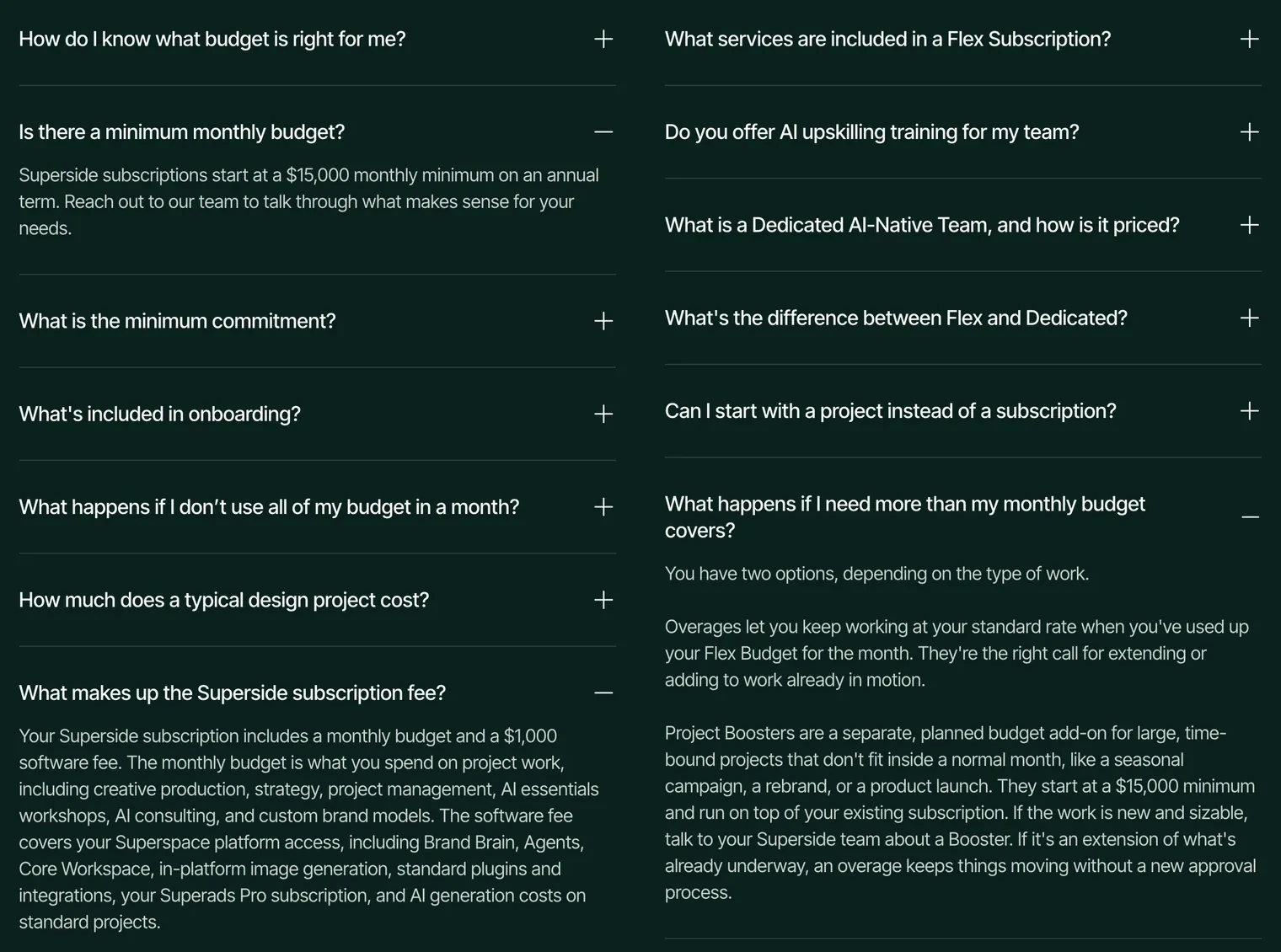
- Subscription: from USD 15,000 a month on an annual term, plus a USD 1,000 monthly software fee for the Superspace platform and Brand Brain. Published.
- Dedicated: from USD 30,000 a month on a twelve-month term, plus the same software fee. You get the same team each month. Published.
- Flex budget: unused budget rolls over for up to three months. Work past the budget continues as overages, with the rate unpriced publicly. Published.
- Quick Start: USD 20,000 for a three-week setup of Brand Brain and stakeholder training. Published.
- Project Boosters: from USD 15,000, added to a subscription for a rebrand, launch or seasonal campaign. Published.
- Exploratory Project: a paid, scoped engagement that Superside describes as “a pathway toward a subscription”. Published.
With the software fee, the entry floor is USD 16,000 a month, or USD 192,000 across the year. Estimated, from the published minimums. The monthly budget pays for project work, including creative production, strategy and project management. New accounts get free onboarding.
4. Why people leave Superside
The minimum commitment is USD 192,000 a year
You may not use the full monthly budget with only a few seed or Series A projects. You still pay for the whole year. Managed services with a creative director offer lower monthly fees on shorter terms. Designity’s Plus plan is USD 5,995 a month for 120 hours, and cancellation requires seven days’ notice before renewal and an exit interview. Published.
Every subscription runs for twelve months
Superside’s pricing page says, “All Superside subscriptions run on an annual commitment.” The Exploratory Project is a paid, scoped way to start before a subscription. You can’t buy a single month of the subscription to try it.
The platform stays with Superside
You keep the deliverables. Superside’s product design page says you own the Figma source files, design tokens and research artefacts, with “no restrictions on internal use, extension, or handoff to other teams or agencies”. The USD 1,000 monthly software fee pays for the Superspace platform and Brand Brain, so that access is tied to the subscription.
Urgent requests can require in-house work
One mid-market customer described a limit on rush requests.
I find that if it’s a rush/urgent project I need support with, that I can’t really lean on Superside and have to do it myself, because their turnaround time does not allow for urgent projects. That would be my only wish as a client.
Lia otherwise praised the team. The limitation concerns her rush requests.
5. The 8 best Superside alternatives for funded tech companies: full comparison
| Option | Best for | Price signal | Timeline signal | Why over Superside |
|---|---|---|---|---|
| Superside | Enterprise creative volume across many formats | From USD 15,000/mo + USD 1,000/mo software, annual Published | Quick Start setup 3 weeks Published | The reference point |
| Refract (us) | A defined brand, product or website project | Brand projects usually $15,000 to $100,000 or more · embedded team $10,000–$30,000/month Published, no currency stated | Timeline agreed by scope Published | Design and build by scope, with an agreed end date |
| Design Pickle | A steady flow of social, ads and decks | Quote on a call Not published | Most requests 1–2 business days Published | A subscription focused on production work |
| Shuttlerock | Paid social and video ad creative at volume | Not published | Not published | Built around ad platforms and creator content |
| Growmodo | Site and landing pages designed and built monthly | USD 3,000/mo per talent Published | Onboarding often within 24 hours Published | Monthly billing, development included |
| Eleken | SaaS product UI and a design system | USD 4,599/mo part-time · USD 6,599/mo full-time Published | Two-month minimum Published | Product-only focus, short minimum |
| Designjoy | One designer at a flat rate | Limited-time USD 4,995/mo, USD 5,995 struck through Published | Most requests in 2 business days or less Published | Pause or cancel at any time |
| C42D | A brand and website project with a published starting price | From USD 20,000 · USD 45,000 · USD 95,000 Published | 6–8 · 8–16+ · 16+ weeks Published | A defined project, no subscription |
| Toptal | One vetted specialist your team directs | Talent rate Not published | Trial of up to two weeks Published | A specialist matched to the work |
1. Refract: best for a defined brand, product or website project
We take on the substantial project within your creative brief: an identity, interface or website. For sites, our builds use Framer, Webflow or custom code, usually Next.js on Vercel. We’re a Webflow Certified Partner (opens in a new tab). A design-only brief works too.
Services. Our services cover identity, interface design and website delivery, with each engagement defined around the work you need.
Price and timeline. Brand projects usually run from $15,000 to $100,000 or more and websites start from $15,000, each priced once for an agreed scope. For product or site work that keeps moving, our embedded team costs $10,000 to $30,000 a month and is agreed month by month. Published, no currency stated.
What clients say. “Love your work Team Refract. From the very first connection, you guys have been sparky and contemporary in your approach. I feel we’re nicely walking that tightrope of pragmatism and creative cut through. Most of all...it’s fun! THANK YOU for the journey travelled so far!” (Andy, VP Marketing, Morse Micro)
Pros. A scoped project has a defined end and no annual creative commitment. Our website engagements cover design and development, so the build has one supplier.
Cons. We don’t run continuous ad production across many markets. Our team concentrates on defined brand, product and website work.
2. Design Pickle: best for a steady flow of production design
Design Pickle runs a brand-trained design team that works through a request platform, where you submit briefs, review drafts and download files. They’re also an official Canva partner and build custom Canva templates for a client’s team.
Services. Their brand-trained team produces social posts, ads, decks and print from the briefs you submit.
Price and timeline. The price is set on a consultation call. Not published. Their pricing page puts the usual turnaround at one to two business days, varying with scope. Published. Their terms define a subscription as a day of output and don’t guarantee an amount of work.
What clients say. 3.4/5 on Trustpilot from 366 reviews.
Pros. A brand-trained team applies your guidelines to recurring graphics after a rebrand. Their Canva templates also let staff make routine variations without submitting every edit as a request.
Cons. App and UI/UX design and development are excluded, leaving product work with another supplier. Four Trustpilot reviewers between January and May 2026 report slow turnaround, from a three-day revision to daily hours that do not roll over.
3. Shuttlerock: best for paid social and video ad creative at volume
Paid social and video campaigns are Shuttlerock’s production focus, supported by a creative platform. Meta and TikTok specialists work on the channel formats, with a roster of creators for user-generated content. The company was founded in New Zealand and has a team of 300 or more in more than a dozen countries. They say they’ve delivered 100,000+ briefs.
Services. Their specialists produce paid social and video ads, with creators supplying content for the campaigns.
Price and timeline. Shuttlerock’s site shows no price or minimum, and we found no directory profile with one. Not published.
Pros. Channel specialists produce the formats each ad platform needs from the campaign brief. The creator roster also supplies user-generated content, reducing the separate sourcing work for your team.
Cons. Neither fees nor minimum commitments are public. Identity or software-interface work sits beyond their paid-ad remit.
4. Growmodo: best for site pages designed and built on a monthly plan
Growmodo designs and builds sites under one subscription. A dedicated project manager routes requests to UI/UX, graphic, web or motion specialists, and quality assurance reviews each delivery. Their service list includes Webflow, Framer and WordPress site builds.
Services. A project manager assigns your design and website requests to specialists, with quality assurance on each delivery.
Price and timeline.
- All-Inclusive: USD 3,000 a month per talent seat for design and development, billed monthly. Six months gives 5% off and twelve months 10% off. Published.
- Partner add-on: USD 1,000 a month more for strategic guidance. Published.
A talent seat permits a single active project. Growmodo says onboarding can often start within 24 hours. Published.
What clients say. 4.8/5 on Trustpilot from 86 reviews.
Pros. The subscription covers site design and development, so landing pages need no separate build supplier. Monthly billing lets you test the arrangement before a longer commitment.
Cons. Specialists are assigned from a pool, so the project manager is your main contact. Each seat covers one active project, and parallel site and campaign work needs a second seat.
5. Eleken: best for SaaS product UI and a design system
A dedicated SaaS designer is the central purchase at Eleken, whose work covers interfaces and user flows. You get a dedicated designer with guidance from their head of design and an operations contact. Their services include redesigns, MVP design, UX audits and design systems. Shotlist and Panjaya.ai are among the companies quoted on their pricing page.
Services. A dedicated designer works on your SaaS screens, redesign or design system with guidance from their head of design.
Price and timeline.
- Part-time: USD 4,599 a month for one SaaS product designer. Published.
- Full-time: USD 6,599 a month for one designer. Published.
- Two full-time designers: USD 11,999 a month. Published.
Each plan has a two-month minimum, and a free three-day trial covers one or two screens. Published.
What clients say. 4.9/5 on Clutch from 127 reviews. “The quality and speed of Eleken are fantastic.” (General Manager, Idera, Inc., 5 stars on Clutch, 8 April 2025)
Pros. A dedicated designer focuses on your SaaS interfaces, with guidance from design leadership. The trial also gives your team a sample of its own screens to assess before committing.
Cons. Identity work needs another supplier. Each plan has a two-month minimum, starting at USD 4,599 a month. Published.
6. Designjoy: best for one designer at a flat monthly rate
With Designjoy, the founder Brett does the work himself without outsourcing. The subscription takes brand, web and product design requests one at a time, including Webflow development, for up to two users.
Services. Brett handles brand, web and product requests himself, including Webflow development.
Price and timeline. Designjoy currently charges USD 4,995 a month, down from a struck-through USD 5,995, as a limited-time offer. Its own turnaround figure is two business days or under for most requests, with complex work running longer. The subscription pauses or cancels whenever you choose, and stopping inside the first week returns 75% of the fee. Published.
What clients say. 3.3/5 on Trustpilot from 2 reviews.
Pros. Brett designs the work personally, giving you direct contact for briefs and feedback. Webflow development is included too, so a site request can cover the build.
Cons. A single active request limits concurrent brand and website work. The two-user allowance also narrows who can brief and review inside the account. Complex tasks take longer than the usual turnaround. Published.
7. C42D: best for a brand and website project with a published starting price
C42D’s senior-only team of four works on positioning, identity, products and WordPress sites in New York City. Their homepage names AI, healthtech, fintech and SaaS as their markets. Current AI, Kindbody and Teal Health are among their published clients. Their services run from positioning and identity to product design and WordPress websites.
Services. Their senior team develops the positioning and identity and designs products and WordPress websites.
Price and timeline.
- Project tier 1: from USD 20,000 for six to eight weeks. Published.
- Project tier 2: from USD 45,000 for eight to sixteen weeks or more. Published.
- Project tier 3: from USD 95,000 for sixteen weeks or more. Published.
- Monthly retainer: from USD 2,500 for ongoing work. Published.
These are starting prices for their project work, with the included services agreed by scope.
What clients say. 4.8/5 on Clutch from 59 reviews. “Thanks to their expertise, we now have a brand we are proud of and excited to share.” (Co-Founder, Gliss Wellness, 5 stars on Clutch, 24 October 2024)
Pros. Published project prices and schedules give finance a budget reference before discovery. The project model also lets you commission the rebrand without moving ongoing creative into another annual contract.
Cons. All sites use WordPress, which rules out a required Framer or Webflow build. The prices are starting figures, so check what implementation each includes.
8. Toptal: best for one vetted specialist your own team directs
For a skill gap you can manage internally, Toptal matches screened freelance designers to hourly, part-time or full-time engagements. A designer is typically introduced within 24 hours, followed by a trial of up to two weeks. Published.
Services. They match you with a screened designer, and your team directs the work.
Price and timeline. You pay for the designer’s hourly, part-time or full-time work. Toptal leaves that rate unpublished and sets it by the person and commitment. Not published. If you’re not satisfied after the trial, they say you won’t be billed.
What clients say. 4.8/5 on Clutch from 53 reviews. “They’re a truly collaborative team.” (Website & Customer Experience Manager, i-Health, 5 stars on Clutch, 13 October 2023)
Pros. Hourly, part-time and full-time arrangements let you choose capacity for a specific design gap. The trial then tests the matched designer on your assignment before the engagement continues.
Cons. Your team directs and reviews the designer’s work, management Superside handles today. The talent rate stays unpublished until a person is matched and quoted.
6. How we picked these alternatives
We assessed which Superside assignments each provider accepts, distinguishing ad production from substantial design projects. Team models and contracts then established whether you buy managed delivery or direct a freelancer. Entry costs, extra fees and commitment length supplied the price comparison.
We left out open marketplaces such as Upwork, where you screen and manage each freelancer yourself. We wrote this list and put ourselves first. No provider was contacted or paid to appear.
7. What an annual creative subscription contract commits you to: term, overage, notice and file rights
An annual creative agreement affects how finance approves work throughout the year. Before signing, name the person who can authorise extra spend and the person who tracks the budget. Ask the provider to show how each request is estimated and how your team can see the remaining balance before approving another project.
Superside’s pricing FAQ leaves the overage rate as “your standard rate”, with no public amount. Not published. Have the sales team put that rate in the proposal, along with any requirement to approve work beyond the available budget. Ask how revisions affect the estimate so finance can authorise changes during design.
The signed agreement also needs attention before the final month. Superside’s public pricing page establishes the annual commitment but gives no early-exit terms. Ask for the renewal date, the deadline and method for giving notice, and the treatment of unfinished work when the term expires. Procurement needs those dates before agreeing when a replacement supplier starts.
File rights need a separate check from account access. Make an inventory of the material the replacement supplier will use, including working files and the brand guidance that informed them. Ask which items can be exported and in what format. Superside gives clients ownership of deliverables but licenses their own platform and AI features for the subscription term.
We scope our project handover around the work the client’s team will own. When a subscription continues during our project, we also agree which provider is responsible for updating shared brand material. That prevents two suppliers from working from different approved versions.
8. When Superside is still the right choice
Superside’s security page describes an annual SOC 2 Type II audit by a third party, Google authentication and single sign-on through OIDC and SAML. If those are buying requirements, include them in your replacement brief and ask for the current audit report before changing providers.
Their subscription may suit recurring work that uses the USD 15,000 monthly project budget, plus the USD 1,000 software fee. One supplier covers the different creative formats. Published.
An in-house creative team at capacity can use Superside for more output without hiring. On Clutch, a Director of Global Marketing at a software company wrote, “Having Superside on our team makes it feel like we have somebody in-house” (5 stars, 27 February 2024). Superside has 4.3 on Trustpilot from 389 reviews and 2.9 on Clutch from 6.
9. Work with us
Shuttlerock and Design Pickle would be our starting points for recurring ad creative and production assets. You can keep that work with a subscription while buying the brand, product design or website separately. This can also let you finish a defined project without committing all your creative work to an annual contract.
Bring us the substantial design project you want to complete. We’ll define our delivery and the work your production provider keeps handling. Our work shows completed projects, and how a project starts explains the engagement. You can tell us what you’d move off Superside to begin that discussion.
10. Questions
Yes. Superside’s AI terms allow clients to request deliverables made without AI and provide account-level and project-level controls. Tell the team which projects need that restriction before production begins. Procurement can then ask how the restriction is recorded and checked for the requested work.
Yes, their landing-page service includes Webflow development. A replacement brief should identify the site platform and whether you are moving the build, ongoing edits or just the page designs. That affects whether you need a developer in addition to a production designer.
Our brand projects usually run from $15,000 to $100,000 or more, with scope and price agreed before work starts. The closer comparison is our embedded team at $10,000 to $30,000 a month, with the people, scope and any minimum term agreed before the first month. Our pricing page names no currency for either figure. A USD 15,000 Superside subscription is a monthly budget for creative production across formats, plus the USD 1,000 software fee. For a move centred on the product interface, the AI startup product design shortlist covers design teams and their engagement models.
A split can work when one supplier produces routine assets and the other owns a defined redesign. Your team will need to coordinate both suppliers and give them the same brand standards. Our Design Pickle alternatives guide compares production subscriptions by price, scope and concurrent requests.
You can request a fixed project quote without an ongoing creative subscription. C42D projects start at USD 20,000, and Ramotion’s Brand Creation package starts at USD 60,000 before the website. Published. Superside’s Project Boosters start at USD 15,000 in addition to a subscription. Published. Our comparison of branding agencies for AI and developer tool startups includes more studios and their published prices.
Written on by
 Refract
 James
 Naiya